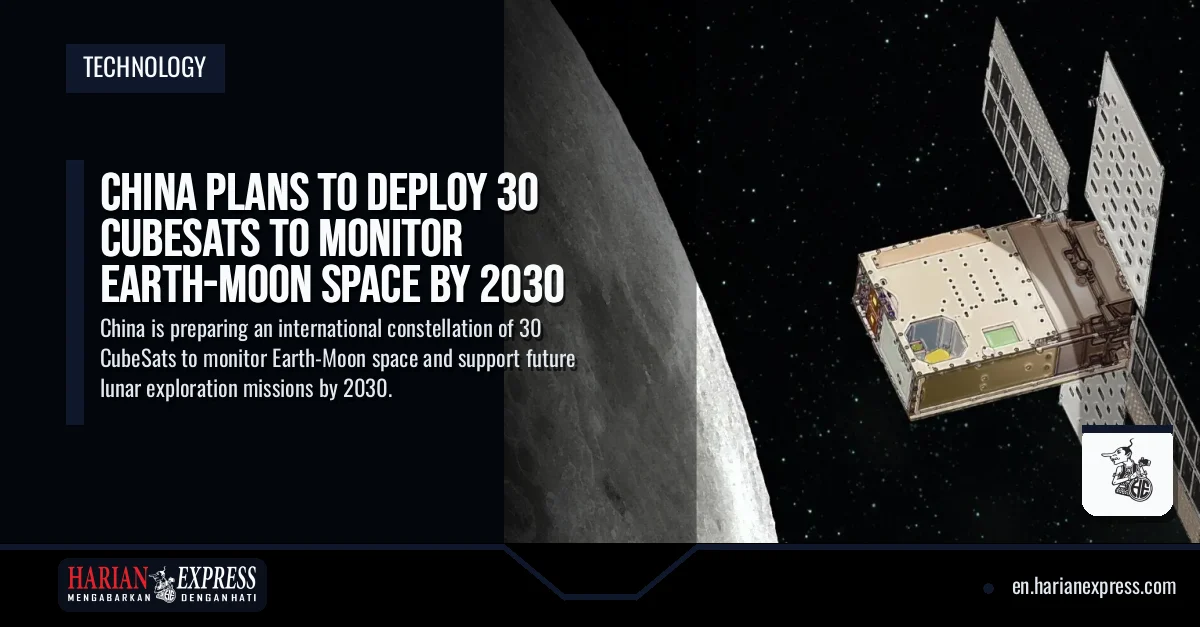
HARIANEXPRESS – China is currently preparing an international satellite constellation featuring 30 CubeSats to monitor the extensive region between Earth and the Moon. This initiative aims to enhance scientific observations and provide support for upcoming lunar exploration missions by 2030.
Officially named the Cislunar CubeSat Constellation (C3) program, the project is engineered to deliver continuous monitoring of the cislunar environment. These satellites are scheduled for launch and deployment prior to 2030.
Dozens of CubeSats to Monitor Cislunar Space
The cislunar region extends from low Earth orbit out to approximately 2 million kilometers from Earth. This area serves as a critical frontier for future human activities in space, which includes crewed missions to the Moon and the creation of future lunar research stations.
Past observations of this sector have predominantly relied on isolated, point-based measurements. This reliance has caused gaps in spatial and temporal coverage while limiting scientific access to data from critical zones.
Within the C3 framework, 30 CubeSats weighing no more than 30 kilograms each will establish an international constellation to monitor the space environment and detect gamma-ray bursts. The satellites will perform synchronized observations from multiple locations, allowing scientists to track space weather events comprehensively.
Supporting Future Human Missions to the Moon
The continuous data produced by this satellite network will offer vital support for the safety of upcoming crewed lunar landing missions. Furthermore, the system will contribute to scientific investigations into the cislunar environment, including space weather and high-energy astronomical phenomena.
This initiative was launched jointly by China’s Deep Space Exploration Laboratory (DSEL) and the International Deep Space Exploration Association (IDSEA), alongside support from the Asia-Pacific Space Cooperation Organization.
Developing Countries Invited to Participate
The C3 program remains open to global scientists and research institutions. China is also extending opportunities for developing countries to engage more actively in deep-space exploration.
Research institutions representing Thailand, Serbia, Egypt, Senegal, and Indonesia have already joined the initiative. The program will offer technical training and standardized interfaces to assist participating nations in contributing to the mission.
The initial phase of technical development has commenced, with design studies for the satellites, payloads, tracking and control systems, and other major components nearing completion.