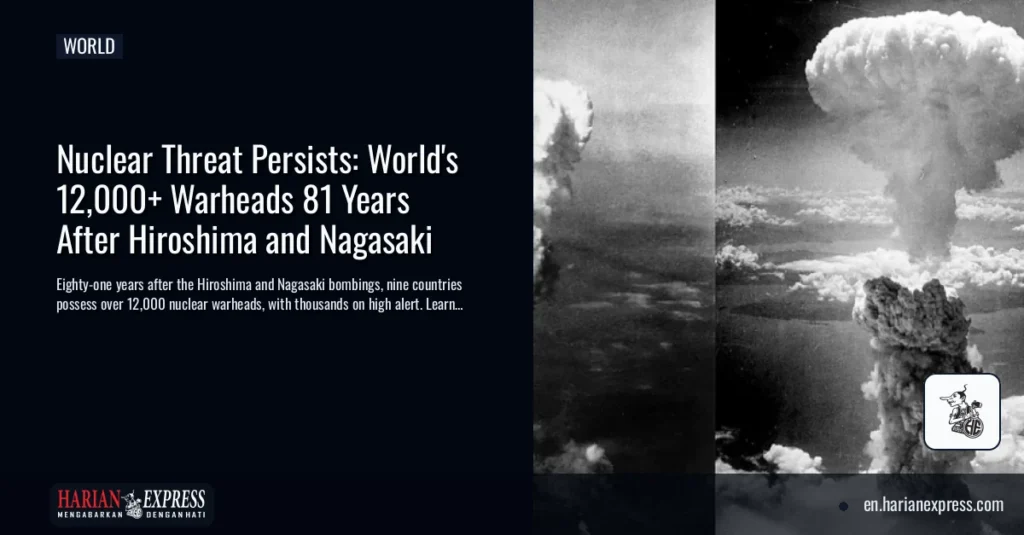
HARIANEXPRESS – Eighty-one years have passed since atomic bombs devastated Hiroshima and Nagasaki at the close of World War II. However, the specter of nuclear threats has not fully vanished. As of early 2026, nine countries are estimated to command over 12,000 nuclear warheads, with varying levels of operational readiness.
The United States dropped the first atomic bomb on Hiroshima on August 6, 1945. Three days later, on August 9, 1945, the second nuclear bomb was deployed on Nagasaki. These two events mark the only instances of nuclear weapons use in warfare to date.
The Hiroshima City government estimates approximately 140,000 people died by the end of December 1945 from the blasts, fires, injuries, and radiation exposure. Authorities in Hiroshima and Nagasaki reported that the death toll in both cities reached around 210,000 by the close of that year. The exact figures are challenging to ascertain due to the extensive destruction and limited record-keeping during that period.
A significant portion of the casualties were civilians. Beyond immediate fatalities, the radiation released by the explosions left lasting health impacts on survivors, known as hibakusha. This tragedy serves as a global reminder of the uncontrollable humanitarian consequences of using nuclear weapons.
World’s Nuclear Arsenal Reaches 12,187 Warheads
The Stockholm International Peace Research Institute (SIPRI) estimates a global inventory of 12,187 nuclear warheads as of January 2026. These weapons are controlled by nine nations: Russia, the United States, China, France, the United Kingdom, India, Pakistan, Israel, and North Korea.
Of this total inventory, roughly 9,745 warheads are in military stockpiles and considered available for potential use. Approximately 4,012 warheads have been deployed on missiles or aircraft bases, while the remainder are held in central storage facilities.
Between 2,100 and 2,200 deployed warheads are maintained at a high operational alert status on ballistic missiles. The majority of these are held by Russia and the United States, with smaller numbers belonging to France and the United Kingdom.
The current global nuclear arsenal is considerably smaller than its Cold War peak. The Federation of American Scientists (FAS) estimated the global inventory reached approximately 70,300 warheads in 1986. However, this overall reduction is primarily due to the United States and Russia dismantling older, retired weapons.
Simultaneously, the number of warheads in military stockpiles has shown an increasing trend.
Russia and the United States Dominate Global Nuclear Inventories
Russia’s Arsenal
Russia continues to hold the largest nuclear inventory. FAS estimates Moscow possesses around 5,420 warheads, comprising 4,400 in its military stockpile and approximately 1,020 retired weapons awaiting dismantlement.
Russia is actively modernizing its missile systems and launch platforms.
United States’ Nuclear Power
The United States ranks second with approximately 5,042 warheads. Of these, about 3,700 are part of its military stockpile, while 1,342 have been retired and are awaiting dismantlement.
The United States is developing new generations of ballistic missiles, strategic submarines, bombers, and non-strategic nuclear weapons.
Combined, these two nations account for about 86 percent of the world’s total nuclear inventory and 83 percent of the warheads in military stockpiles. Both Russia and the United States maintain a nuclear triad, which includes land-based missiles, strategic bombers, and nuclear-armed submarines.
China Expands Nuclear Capacity Rapidly
China holds the third position with an estimated 620 nuclear warheads. While this number remains significantly lower than the arsenals of Russia and the United States, Beijing is noted as the country expanding its nuclear capabilities most rapidly in recent years.
SIPRI estimates that China has deployed hundreds of missiles in three large silo complexes in its northern regions. Beijing is also strengthening its intercontinental ballistic missiles and sea- and air-based nuclear capabilities.
Should this expansion persist, China could potentially possess at least 1,000 warheads by the end of the decade. However, this figure is still projected to be roughly a quarter of the current military stockpiles of Russia or the United States.
France and United Kingdom as European Nuclear Forces
France’s Nuclear Deterrent
France is estimated to possess a total of 370 warheads, with about 80 having been retired and awaiting dismantlement. This places its military stockpile at approximately 290 warheads.
France’s nuclear capabilities are primarily based on ballistic missile submarines and nuclear-capable fighter jets.
United Kingdom’s Submarine-Based Arsenal
The United Kingdom possesses an estimated 225 warheads, with about 120 believed to be deployed with operational forces.
The UK’s arsenal relies entirely on submarine-launched ballistic missiles. The British government previously increased its maximum nuclear stockpile limit to no more than 260 warheads.
Beyond these national arsenals, some B61 nuclear bombs belonging to the United States are reportedly stationed at several NATO member bases in Europe.
India and Pakistan: South Asia’s Nuclear Landscape
India and Pakistan, two neighboring countries in South Asia, are estimated to possess a combined total of around 360 nuclear warheads. India controls approximately 190 warheads, while Pakistan has about 170 units.
India is believed to be expanding its arsenal and developing longer-range delivery systems. In addition to its long-standing rivalry with Pakistan, New Delhi’s nuclear program is increasingly oriented towards reaching targets in China.
Pakistan is also developing new delivery systems and increasing its production of fissile material that can be used for weapons. Tensions between these two nations remain a global concern, as they have engaged in armed conflicts and border disputes multiple times.
North Korea and Israel Maintain Secrecy
North Korea’s Developing Program
North Korea is estimated to have assembled around 60 nuclear warheads, though the exact number is difficult to verify. FAS suggests Pyongyang has enough fissile material to produce at least 90 warheads.
North Korea’s nuclear program continues to advance through ballistic missile tests and the development of new launch capabilities.
Israel’s Ambiguous Stance
Israel is estimated to possess about 90 nuclear warheads. However, the Israeli government has never officially confirmed or denied its ownership of such weapons.
This policy of ambiguity makes the size and composition of Israel’s arsenal challenging to determine independently.
The varying levels of transparency among nuclear-weapon states mean that all these figures should be regarded as estimates. Data concerning the stockpiles, deployment, and operational readiness of nuclear weapons is generally classified by states. Researchers rely on government information, satellite imagery, historical records, defense reports, and other open-source intelligence to derive their assessments.
The Threat of a New Arms Race
SIPRI notes that all nuclear-weapon states continued modernization programs in 2025. Some countries even increased their stockpiles or elevated the role of nuclear weapons in their national security strategies.
This trend unfolds as the international arms control regime faces significant pressure. The expiration of the New START Treaty in February 2026 heightens uncertainty regarding the future limitation of strategic nuclear forces for the United States and Russia.
Eighty-one years after the devastation of Hiroshima and Nagasaki, the world has not witnessed another use of nuclear weapons in warfare. However, the presence of over 12,000 warheads—thousands of which are deployed with launch systems—demonstrates that nuclear risk remains a tangible issue in global security.
The commemorations of Hiroshima and Nagasaki are therefore not merely moments to remember the victims. This tragedy also serves as a call for diplomacy, arms control, and a commitment to disarmament to be prioritized in safeguarding global peace.