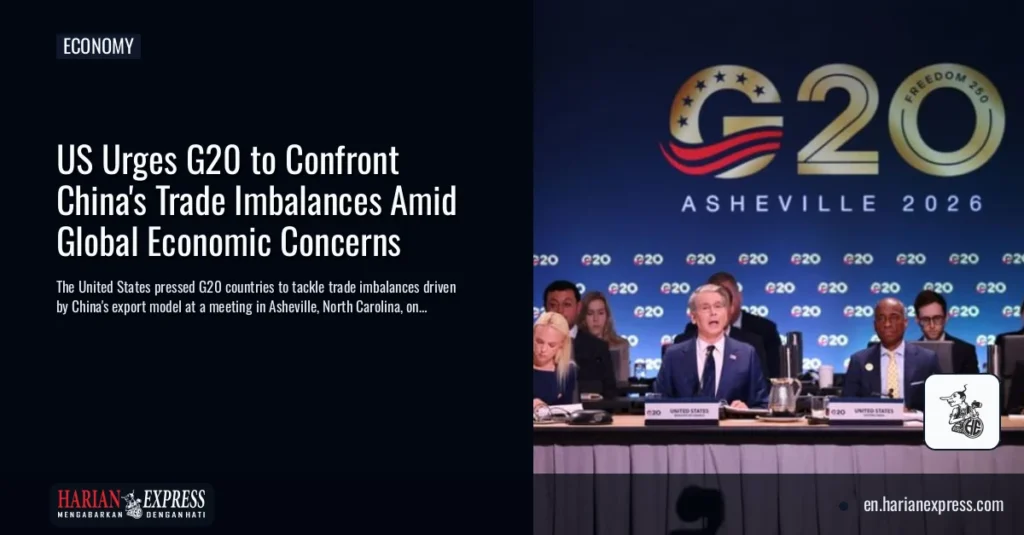
HARIANEXPRESS – The United States called on fellow G20 countries to take stronger action against global trade imbalances, with a specific focus on China’s export-driven economic model. This appeal came during a two-day meeting of finance ministers and central bank governors in Asheville, North Carolina, starting on Tuesday, September 1, 2026. The discussions took place amidst global concerns over rising debt levels and pressures from inflation.
G20 Confronts Global Trade Imbalances
During the G20 meeting, US Treasury Secretary Scott Bessent warned that tough US tariffs would likely cause Chinese goods to be diverted to other markets.
He told the gathering in Asheville that other nations “probably needs to take a hard look at what they should be doing to protect their citizens’ jobs.”
US Urges Action Against “Non-Market Economies”
Secretary Bessent further stated that many non-market economies exhibit significant imbalances.
“And unfortunately, I was right. They have – and the rest of the world probably needs to take a hard look at what they should be doing to protect their citizens’ jobs,” he told the meeting in Asheville, North Carolina. “We’re seeing a lot of non-market economies with these big imbalances that are sucking growth from the rest of the world,” Bessent told.
He previously cautioned trading partners about this issue last year.
Europe’s Concerns and Broader Economic Pressures
China’s substantial export drive has put pressure on economies worldwide, particularly as the United States implemented high tariffs and bans on certain Chinese products.
With consistently weak domestic demand, China has intensified its exports of electric vehicles, semiconductors, and other goods.
Its total exports increased by 23.9 percent year-on-year in July, leading to growing calls in Europe for tougher restrictions on Chinese imports.
Polish Finance Minister Andrzej Domanski noted the significant undervaluation of Chinese currency and China’s active subsidization of its exports.
“We do know that Chinese currency is hugely undervalued, that China is supporting, very actively subsidising its exports and this is a problem for Europe as well,” Polish Finance Minister Andrzej Domanski.
Last year, China’s goods trade surplus with the European Union reached €360.6 billion (US$418 billion), marking a 15 percent increase from 2024.
This surplus has expanded further in 2025 as Chinese firms sold more to the EU while importing less.
European Economy Commissioner Valdis Dombrovskis acknowledged China as a primary source of economic imbalances.
However, he also stated that both the US and Europe share responsibility in balancing these issues.
German Finance Minister Lars Klingbeil pointed out that the US- and Israeli-led Iran war, along with ongoing US tariff disputes, significantly contribute to global economic uncertainty.
“Uncertainty is poison for economic growth,” Klingbeil said. “The tariff conflicts being pursued by the US, such as the current dispute with Canada, destroy trust.”
China’s Export Practices and Critical Mineral Curbs
G20 member China has displayed little interest in long-standing requests for it to reduce industrial subsidies and rebalance its economy.
Its yuan currency remains considerably undervalued by most estimations.
Additionally, Beijing has leveraged its dominant position in critical mineral processing by imposing export restrictions on rare earths in April 2025.
This measure was a response to US President Donald Trump’s tariffs, impacting non-US companies.
Japanese Finance Minister Satsuki Katayama addressed her G20 counterparts on Monday evening, stating that arbitrary export restrictions on critical minerals are detrimental to the global economy.
She emphasized that these restrictions should be withdrawn.
Divisions Hinder Joint Communique
It remains uncertain whether the US will succeed in uniting the diverse forum to agree on a joint communique aimed at reducing global imbalances.
Officials indicated that the section regarding global imbalances in the proposed communique was proving particularly challenging.
China opposed any specific mention of “non-market economies” or strong language regarding critical mineral supply restrictions.
European countries also aimed to include strong critical language concerning Russia’s war against Ukraine.
They expressed dismay over their Russian counterpart’s presence at the forum, marking the first time since Russia’s invasion of Ukraine in 2022.
Global Bond Market Sell-off and Yen Outlook
A global bond market sell-off intensified on Tuesday.
Japan’s 10-year bond yield reached 3 percent for the first time since 1996.
This development reflected investor anxiety about energy-driven inflation, potential monetary tightening, and deteriorating fiscal conditions.
Treasury officials reported that Secretary Bessent advocated for sound monetary policy to stabilize inflation expectations and prevent excessive currency volatility during his Sunday meeting with Bank of Japan Governor Kazuo Ueda.
“I have information that the market doesn’t have, and it’s my belief that the Japanese government and the BOJ will do the things that will lead to a stronger yen,” Bessent told.
These comments underscore Bessent’s recent calls for the Bank of Japan to raise interest rates, potentially strengthening the case for Ueda to propose a hike at the bank’s policy meeting on September 17-18.