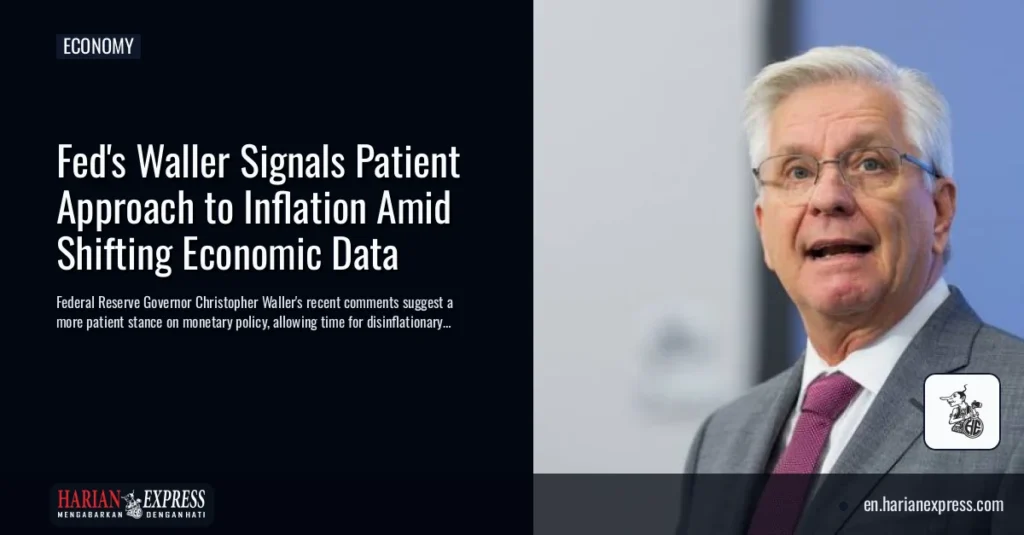
HARIANEXPRESS – Recent statements from Federal Reserve Governor Christopher Waller suggest a more cautious direction for the central bank’s future monetary policy. Waller’s remarks indicate that policymakers may now allow additional time for disinflationary trends to solidify before considering further adjustments to interest rates.
This development has influenced global financial markets, as investors reassess the likelihood of immediate rate hikes. The shift underscores a growing reliance on incoming economic data, particularly concerning inflation and the labor market.
Federal Reserve Signals Patient Stance Amid Economic Shifts
Federal Reserve Governor Christopher Waller has communicated a measured outlook on monetary policy, indicating a departure from a previously aggressive approach. His comments suggest the central bank is prepared to observe how inflationary pressures evolve over a longer period.
Policymakers are reportedly focusing on whether recent improvements in inflation dynamics can be sustained. This emphasis has notably reduced market speculation about another imminent interest rate increase.
Waller’s Remarks Shape Market Expectations
Waller’s statements highlight the Federal Reserve’s reliance on concrete economic data to guide its decisions. Rather than a swift tightening, the focus is now on confirming the sustainability of current disinflationary trends.
This revised perspective has influenced investor sentiment across various markets globally. Both bond yields and equity markets have reacted positively to the perception that the Fed might adopt a more patient stance.
Investors are actively adjusting their positions as they recalibrate the probability of additional monetary tightening. This reevaluation reflects a cautious optimism regarding future central bank actions.
Inflation Outlook Remains Complex Despite Signals
Despite the signals for a more patient approach, the overall inflation outlook continues to present complexities. Rising energy prices, alongside other cost pressures, still pose potential risks to the ongoing disinflation process.
These factors reinforce the Federal Reserve’s careful approach, as policymakers seek stronger evidence that inflation is consistently moving toward its long-term target. The central bank aims for a sustainable reduction in price pressures.
The Fed’s next move will likely be determined less by a single data point and more by the consistency of the broader inflation trend.
“The Fed’s next move will likely be determined less by a single data point and more by the consistency of the broader inflation trend. Waller’s signal suggests that policymakers are increasingly willing to wait for clearer evidence before making additional rate decisions, creating a more balanced but still uncertain outlook for global markets.”
This insight, originating from a market strategist commentary based on Reuters reporting, indicates a nuanced shift in the central bank’s strategy.
Crucial Economic Data to Guide Future Policy Decisions
Upcoming releases of labor market and inflation data are set to become critical in determining the Federal Reserve’s subsequent policy choices. Markets are now scrutinizing not only the direction of interest rates but also the broader implications for economic stability.
The market is increasingly attentive to the Fed’s confidence in the durability of economic normalization. Waller’s signal thus reflects a central bank transitioning from aggressive inflation control to a more balanced, data-dependent framework.
The coming weeks will likely reveal whether the current inflation moderation is robust enough to support a pause in tightening. Conversely, renewed price pressures could necessitate further policy intervention from the Federal Reserve.