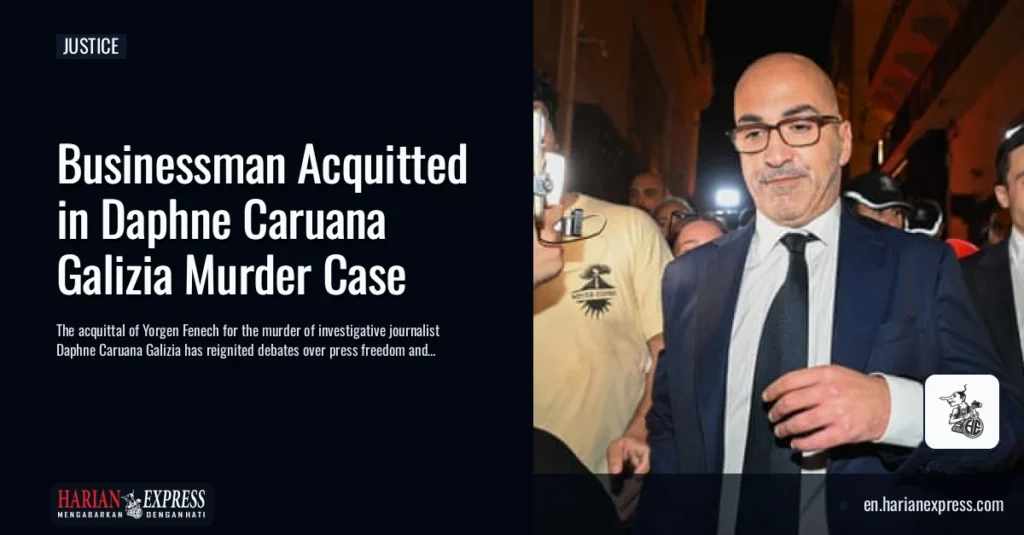
HARIANEXPRESS, VALLETTA – Maltese businessman Yorgen Fenech was acquitted on Wednesday, September 2, 2026, of charges related to the 2017 car bomb killing of investigative journalist Daphne Caruana Galizia, sparking widespread outrage and renewed calls for accountability in the Mediterranean island nation.
The not-guilty verdict, delivered by a jury in an 8-1 vote at 7:30 PM, came nearly nine years after Caruana Galizia’s assassination. Fenech, one of Malta’s wealthiest figures, had been accused by prosecutors of masterminding the slaying and paying €150,000 to have her killed.
Caruana Galizia, 53, was killed on October 16, 2017, when a car bomb detonated near her home in Mosta. She was renowned for her extensive anti-corruption investigations, targeting high-level political and business figures and exposing alleged offshore companies and questionable deals, including a controversial power station contract involving Fenech’s consortium.
“Justice denied,” ujar Matthew Caruana Galizia (Daphne’s eldest son).
Caruana Galizia’s sister, Corinne Vella, told reporters after the verdict, “This signals you can kill journalists with impunity.” Reporters Without Borders expressed being “beyond outraged” by the decision.
The journalist’s family stated that the verdict denied her “justice she deserves,” adding, “Nine years after Daphne’s brutal assassination, the institutional failures that enabled her murder remain unaddressed and unreformed.” They emphasized that “Our country failed to protect Daphne. It owes it to her to prevent other lives being lost.”
The acquittal came after Malta’s longest-running murder trial, which gripped the small country for 55 days. While Fenech was cleared, several others have been convicted for their roles in the assassination: Vincent Muscat pleaded guilty in 2021 and was sentenced to 15 years, George and Alfred Degiorgio pleaded guilty in 2022 and each received 40-year sentences, and Jamie Vella and Robert Agius were sentenced to life in prison in 2025 for supplying the bomb.
Caruana Galizia’s murder triggered a political crisis that led to the resignation of then-Prime Minister Joseph Muscat in 2019, following Fenech’s arrest. An independent inquiry in 2021 concluded that the Maltese state “has to bear responsibility” for the assassination due to a culture of impunity.
The case has also highlighted the pervasive use of Strategic Lawsuits Against Public Participation (SLAPPs) to silence journalists; Caruana Galizia faced 47 such lawsuits at the time of her death. European Parliament President Roberta Metsola pledged to continue fighting for justice, noting, “When they assassinated you, in broad daylight, outside your family home, we promised that we would not let them sweep it under the carpet… That promise holds today.”
Juliette Garside, a Guardian reporter involved in the Daphne Project, observed that the verdict feels like a “chilling verdict” for the Maltese media. She stated, “Hopefully this will be an impetus for EU member states to put this law on to their statute books.”
The Committee to Protect Journalists’ Deputy Advocacy Director, Tim Gibson, described the verdict as “heartbreaking for her family, who – almost nine years after her death – are still waiting for justice.” He affirmed the group’s commitment to seeking accountability for all involved in her murder.