
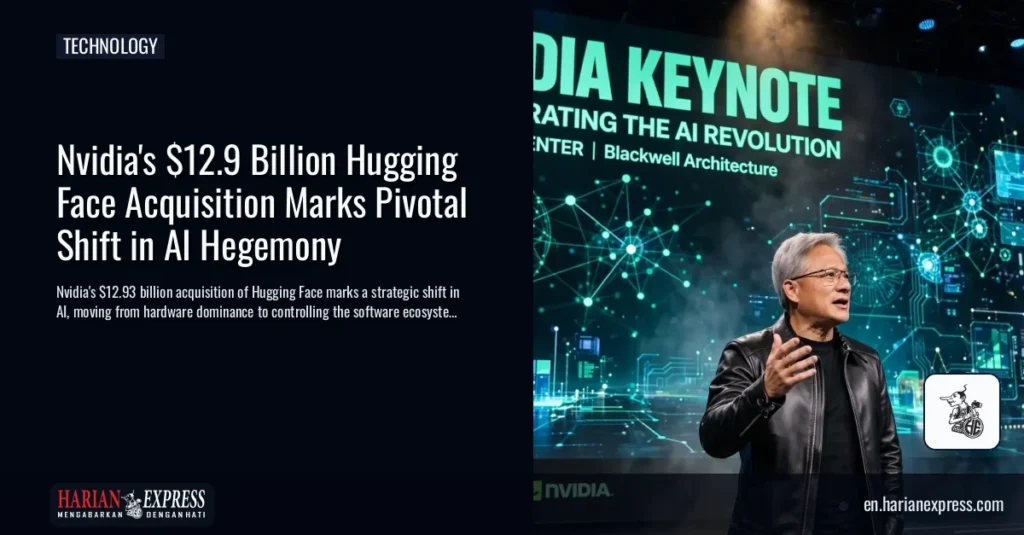
HARIANEXPRESS – The global artificial intelligence (AI) industry is currently undergoing a significant transformation in its competitive landscape. A historic shift is marked by Nvidia’s strategic investment in Hugging Face, valued at $12.93 billion. This acquisition signals that control over the developer community and model distribution is now as crucial as computing silicon ownership.
A Strategic Shift Towards AI Ecosystem Control
The artificial intelligence industry is witnessing a significant shift from hardware dominance to control over the software ecosystem and model distribution channels.
Nvidia’s strategic investment in Hugging Face, valued at $12.93 billion, marks a pivotal moment in technology history.
This valuation, which seems to defy conventional market logic for a platform with an annual recurring revenue (ARR) between $100 million and $150 million, goes beyond simple revenue calculations for Nvidia.
Instead, it represents a calculated move to mitigate the risks of hardware commoditization by gaining control over the software layer.
Nvidia is employing a precise blend of defensive and offensive strategies to achieve this.
Defensively, the company acknowledges potential saturation in the GPU market and the rising threat from competitors developing internal AI chips.
untuk melindungi pangsa pasar chip mereka. Secara ofensif, langkah ini membangun ketergantungan perangkat lunak (software lock-in), memastikan bahwa setiap model yang dikembangkan di platform tersebut memiliki kompatibilitas tertinggi dengan arsitektur Nvidia.
By dominating the largest model distribution platform, Nvidia establishes a strong ‘fortress’ to protect their chip market share, while offensively, this move creates software lock-in, ensuring optimal compatibility for models developed on the platform with Nvidia’s architecture.
This long-term hedging strategy includes several crucial points.
Mitigating Hardware Commoditization
One key point is the mitigation of hardware commoditization, allowing Nvidia to avoid the trap of declining margins on hardware by transitioning to an ecosystem platform provider.
Secondly, it diversifies revenue streams, transforming Nvidia from merely a component vendor into an owner of AI distribution infrastructure with subscription monetization potential.
Finally, it ensures the mastery of entry points, guaranteeing that the mainstream of AI innovation remains within Nvidia’s sphere of influence.
Ultimately, this premium valuation is not based on current cash flow but on the control of a far more valuable strategic asset: deep developer behavioral intelligence.
‘Developer Telemetry’ as Nvidia’s Secret Weapon
In advanced technology development, the ability to foresee market directions before trends fully emerge is a critical competitive advantage.
Through this acquisition, Nvidia effectively gains access to the world’s most comprehensive market intelligence system in AI, termed “Developer Telemetry.”
Serving 18 million developers, hosting 3 million models, and utilized by 200,000 companies, Hugging Face acts as a real-time radar for Nvidia.
This synthesis of information provides significant strategic advantages:
- 1. Early Detection of Architecture Trends: It enables Nvidia to detect shifts in AI model preferences and dataset structures before they become industry standards.
- 2. Real-Time Chip Design Optimization: Nvidia can adapt the design of future chip generations based on the most frequently used workloads by the community in real-time.
- 3. Infrastructure Needs Prediction: Understanding global computational power consumption patterns guides DGX Cloud development more accurately.
This informational edge empowers Nvidia to optimize their silicon for future model requirements well before competitors recognize these shifts.
However, this consolidation of power has sparked debates concerning the future of the open-source ethos that has long been integral to the community.
The Test of Neutrality in the Open-Source Community
Hugging Face’s strategic value stems from community trust and its spirit of openness.
Post-acquisition, skepticism has arisen regarding whether the platform will remain a “pelabuhan netral” or become a tool to strengthen the exclusivity of Nvidia’s ecosystem.
Jensen Huang publicly expressed his commitment to maintaining a “platform multi-cloud dan multi-akselerator yang netral” and continuing to support open-weight models.
This commitment is vital to prevent developers from migrating to alternative platforms.
However, an inherent tension exists between this promise and deeper technical integration into Nvidia’s infrastructure.
- Promises of Neutrality: Continued support for rival cloud platforms (AWS, Azure, GCP), and compatibility with non-Nvidia AI accelerators.
- Risks of Vendor Lock-in: Superior performance optimization primarily within the Nvidia ecosystem, and exclusive features accessible only through Nvidia hardware.
- Open-Source Support: Full support for open-source/open-weight models, contrasted with the utilization of developer interaction data to strengthen Nvidia’s internal models.
Nvidia’s success in balancing these aspects will determine if Hugging Face remains a global innovation hub or merely becomes a closed distribution channel.
Technological Integration: DGX Cloud, NIM, and Computing Accessibility
A crucial technical outcome of this acquisition is vertical integration, which reduces barriers between model discovery and industrial-scale implementation.
By integrating NIM (Nvidia Inference Microservices) and DGX Cloud into the Hugging Face ecosystem, Nvidia creates an unbroken distribution pipeline for global companies.
NIM plays a critical role in standardizing AI deployment through containerization, enabling models to run consistently across all Nvidia infrastructure, both in the cloud and on-premise.
This synergy allows developers to select a model on Hugging Face and launch it directly onto DGX Cloud infrastructure with minimal latency.
Effectively, this simplifies a previously complex workflow into a “satu klik,” process, accelerating the training and inference cycle for businesses.
This comprehensive technical integration not only streamlines operations but fundamentally shifts the industry power map towards absolute ecosystem control through the provision of globally standardized infrastructure.
Conclusion and Future Projections
The acquisition of Hugging Face for $12.93 billion is a strategic orchestration redefining the boundaries of power in the AI era.
This move indicates that while coexistence between open-source models and closed systems will persist, infrastructure control will increasingly centralize with one dominant entity.
Nvidia has fully transformed; they are no longer just a “penyedia senjata” or hardware manufacturer for AI industry competitors.
Instead, they have become the owner of the “jalan raya utama” (distribution channel) through which all global AI model traffic flows.
By mastering the intersection of research, community, and computing, Nvidia now holds sway over the future direction of technological sovereignty.
Future projections suggest that winning the AI race will no longer solely depend on possessing the fastest chips, but on wielding the deepest influence over the ecosystem where intelligence is developed and distributed.