
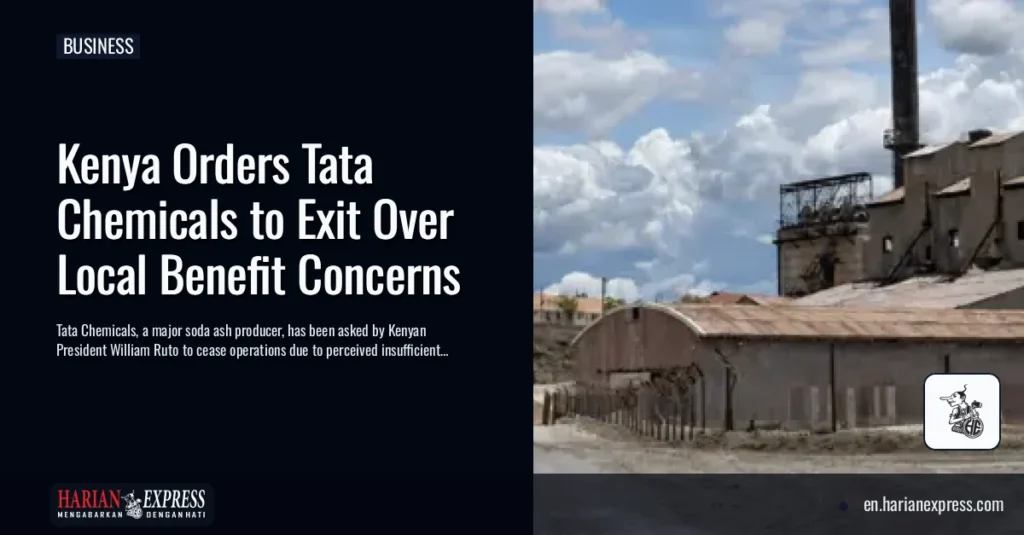
HARIANEXPRESS – President William Ruto has directed Indian conglomerate Tata Chemicals to exit Kenya, citing the company’s failure to provide sufficient benefits for the country. This directive came during a recent visit to Kajiado county, where Tata Chemicals Magadi operates its plant. Ruto stated the government has identified new investors to take over operations, aiming to boost local employment and investment for Kenyans. Tata Chemicals, a leading soda ash producer, expressed its commitment to resolving the matters through legal channels.
President Ruto’s Directive and Rationale
President William Ruto explicitly instructed Tata Chemicals to “pack up and leave,” accusing the company of not adequately contributing to Kenya’s economy.
He criticized Tata Chemicals for primarily exporting raw soda ash instead of processing the mineral locally to produce glass and other chemicals within the country.
“Tata Chemicals Magadi has had a contract for 100 years, and they have done nothing. I told them the other day to pack up and leave,” Ruto stated in Swahili. “They have not built anything in Kajiado, they have not built any factory in Kajiado.”
The President indicated that new investors are already lined up to replace Tata Chemicals in the country.
The goal is to bring more employment opportunities and investment for Kenyans.
Ruto’s comments were made during a visit to Kajiado county, the base for Tata Chemicals Magadi’s plant.
This presidential intervention follows a directive issued five weeks prior by Kenya’s mining minister, who reportedly ordered Tata Chemicals Magadi to suspend its operations.
The suspension was purportedly due to the company’s alleged failure to make royalty payments and meet other regulatory requirements.
Tata Chemicals’ Operations in Kenya
Tata Chemicals Magadi, a part of the Indian conglomerate Tata Group, operates its significant plant at Lake Magadi.
This location is situated approximately 120km (75 miles) southwest of the Kenyan capital, Nairobi.
The company stands as Africa’s largest soda ash producer and is also recognized as one of Kenya’s primary mineral exporters.
It specializes in extracting the mineral trona from Lake Magadi, which it then processes into soda ash.
Soda ash, also known as sodium carbonate, is mainly produced from natural brines or the mineral trona.
This processed soda ash serves as a key ingredient in various industrial applications, including glassmaking.
Further uses for soda ash extend to detergents, chemicals, water treatment, textiles, paper, and even batteries.
Annually, Tata Chemicals exports over 350,000 tonnes of soda ash to global markets.
These markets notably include India, Southeast Asia, the Middle East, and other regions across Africa.
Specifically, more than 95% of its product is exported to Southeast Asia, the Indian subcontinent, Africa, and the Middle East.
In addition to soda ash, the company also produces natural salt for both industrial and animal-feed uses.
According to the US Geological Survey, Kenya ranks as the world’s fourth-largest producer of natural soda ash.
The nation’s production accounts for 1% of the total global output.
The company’s 2024 accounts disclosed sales of approximately 245,000 tonnes of soda-ash.
These operations generated a turnover amounting to $78.7m.
Tata Chemicals directly employs around 500 people in its Kenyan operations.
The company also states that its community programs provide benefits to roughly 30,000 people in the area surrounding Magadi.
These programs offer support in critical areas such as water, healthcare, education, and infrastructure.
Company’s Response and Historical Context
Tata Chemicals stated it respects the government’s decision regarding its operations in Kenya.
The company affirmed it remains “committed to constructive engagement through the appropriate legal and regulatory channels to resolve the outstanding matters.”
The company also emphasized its significant role in the Kenyan economy since acquiring the plant in 2005.
It stated that since its acquisition, “it has played an important role in the Kenyan economy and continues to be an integral part of our business.”
Tata Chemicals has provided a comprehensive response to the ministry regarding its compliance with applicable regulatory requirements.
The company is currently awaiting a review of its submissions and further direction from the Kenyan authorities.
The factory’s presence at Lake Magadi has a long history, with its origins dating back to 1911.
A major mining lease was officially signed with the Kenyan government in 1928, solidifying its presence.
Tata Chemicals took over operations in 2005 when it acquired the UK-based Brunner Mond Group.
The situation highlights a push by the Kenyan government to ensure that foreign investments yield greater local processing and job creation benefits for the nation.
The future of soda ash production at Lake Magadi now hinges on the engagement between Tata Chemicals and the government, alongside the introduction of new identified investors.