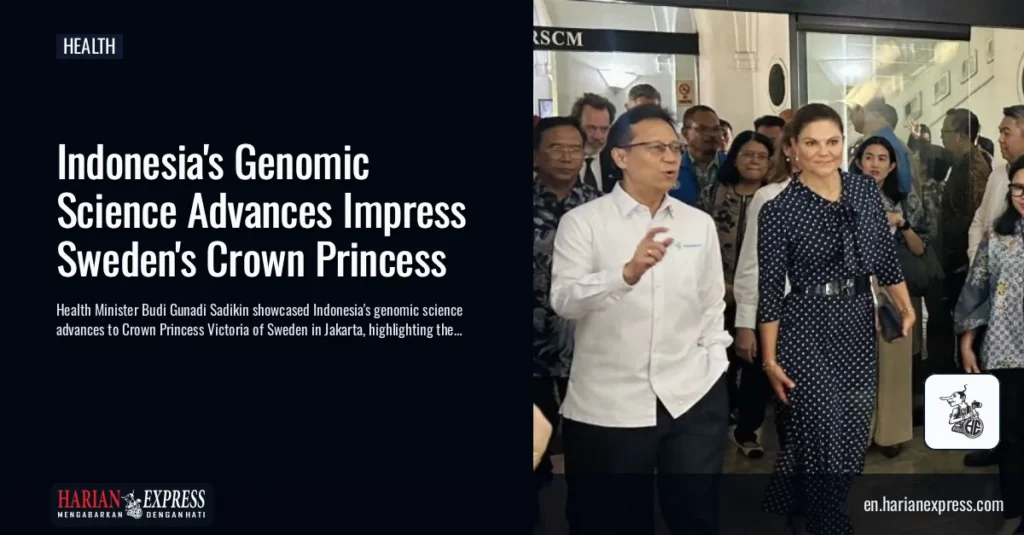
HARIANEXPRESS – Health Minister Budi Gunadi Sadikin presented Indonesia’s significant advancements in genomic science and precision medicine to a prominent international guest. The presentation was made to Crown Princess Victoria of Sweden during her recent visit to Jakarta.
The official engagement took place on Friday at the Center for Biomedical and Genomics for Health. This facility is notably housed within the Eijkman Building in Jakarta, serving as a hub for advanced research.
Crown Princess Victoria participated in the visit in her capacity as an Honorary Ambassador for the United Nations Development Programme (UNDP). Her role underscores the international significance of Indonesia’s scientific efforts.
Indonesia Showcases Genomic Progress to Swedish Crown Princess
During her tour of the facility, Princess Victoria received an overview of the national Biomedical and Genome Science Initiative (BGSi). This ambitious initiative leverages state-of-the-art genomic technology for critical applications.
The primary goals of the BGSi include strengthening individual healthcare services across Indonesia. It also aims to bolster the nation’s preparedness for potential epidemics.
Minister Budi noted the strong interest expressed by the Swedish royal in Indonesia’s rapid adoption of these advanced genomic frameworks. Such sophisticated approaches are typically concentrated in high-income countries.
“She was interested because she did not realize Indonesia was already doing this,” Minister Budi said following the tour.
The Minister further elaborated on the global landscape where similar initiatives are being pursued. He highlighted that these programs are actively implemented across various developed regions worldwide.
These regions include Europe, America, the United Kingdom, and the United Arab Emirates. He observed that wealthy nations often prioritize longevity for their citizens.
“This is an initiative being implemented in Europe, America, the UK, and the UAE. Rich countries want longevity, right? Rich people do not want to die early; they want to live to 120 or 130,” he added.
Precision Medicine Driven by DNA Mapping Expansion
Minister Budi explained that the process of mapping human DNA is fundamental to modern medicine. This technique empowers medical personnel and researchers to identify specific genetic markers.
These identified markers are directly linked to various diseases, providing invaluable insights. Consequently, this allows for the development of future diagnoses and treatments.
Such medical interventions can be precisely tailored to an individual patient’s unique biological profile. This approach ushers in an era of highly personalized medicine.
Previously, genome sequencing technology found its primary use in identifying the characteristics of viral traits. However, Minister Budi emphasized that Indonesia is now significantly broadening its application.
The nation is expanding this technology’s use to meticulously analyze complex human genetic structures. This strategic shift represents a major advancement in Indonesia’s biomedical research capabilities.
“Viruses only have 30,000 base pairs. Humans have 2 billion. So, for example, if someone’s kidneys are damaged, we have to identify one of their DNA fragments. We have to find the one,” he added.
To establish a truly comprehensive national genomic database, the Health Ministry is undertaking a crucial integration effort. It is combining genetic data from both hospital patients and healthy individuals.
This inclusive approach ensures a broad and representative dataset for research and development. The ministry is committed to building a robust foundation for genomic understanding.
Furthermore, the ministry is actively working to expand its data storage infrastructure. This expansion is vital to accommodate the immense volume of genetic information being collected.
The current capacity stands at 4.5 petabytes, which the ministry aims to significantly increase. The ambitious target is to reach a total capacity of 10 petabytes.
The BGSi initiative, benefiting from the support of the UNDP, has successfully established a network of specialized facilities. This includes 10 specialized genomics centers located across the country.
Additionally, 29 national surveillance laboratories have been set up as part of the initiative. These facilities are instrumental in advancing genomic research and monitoring health trends nationwide.
A significant long-term objective of the BGSi initiative involves extensive genetic sequencing. The program aims to sequence a total of 400,000 human genomes by 2030.
Crown Princess Victoria’s Four-Day Official Tour
The tour conducted at the Eijkman Building marked the official commencement of Crown Princess Victoria’s four-day visit to Indonesia. Her comprehensive itinerary includes scheduled stops in multiple key locations.
These locations encompass both the bustling capital city of Jakarta and the scenic island of Lombok. The visit highlights a diverse range of Indonesian progress.
Her official agenda is primarily focused on several important areas of Indonesia’s development. These include the nation’s progress in genomic science and advancements in healthcare digitalization.
Other key areas of focus are the development of blue ecosystems and indigenous forest preservation efforts. Initiatives related to sustainable community development are also on her agenda.