HARIANEXPRESS – Digital transformation for micro, small, and medium enterprises does not always have to begin with complex technology. For many business owners, it can start with something as practical as recording sales, tracking inventory, calculating production costs, and organizing business information more systematically.
This approach was introduced by the Community Service Team of Universitas Negeri Jakarta (UNJ) through a training and mentoring program for women entrepreneurs affiliated with IPEMI PC Bojongsari Depok.
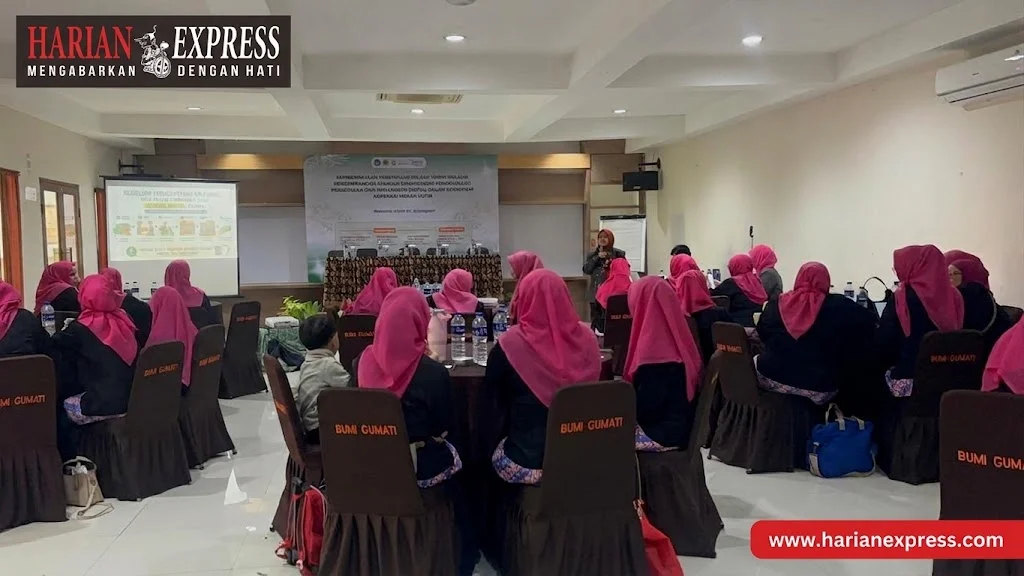
Held on July 30, 2026, the program combined hands-on training, digital technology assistance, business management education, and evaluation activities to help participants strengthen their day-to-day business operations.
One of the key technologies introduced during the program was SmartPOS UMKM, a smartphone-based application designed to support transaction recording, inventory management, product data management, and other essential business information.
The program also strengthened participants’ understanding of production costs, Cost of Goods Sold (COGS), inventory management, and digital marketing through social media and online marketplaces.
Turning Smartphones into Practical Business Tools
Rather than relying solely on classroom-style instruction, the program placed strong emphasis on hands-on practice.
Participants were guided through the use of SmartPOS UMKM directly on their smartphones. They learned how to record incoming and outgoing inventory, sales transactions, product information, and other business-related data.
The practical approach was considered important because MSMEs operate under different conditions. Each business has its own products, transaction patterns, inventory levels, and administrative needs.
The UNJ team therefore provided assistance that allowed participants to understand the application while adapting its features to their respective businesses.
Windy Permata Suyono, S.Ak., M.Ak., a member of the UNJ Community Service Team, said that technology should respond to real business needs rather than become an additional burden for entrepreneurs.
“We want technology to be more than just an application introduced during training. It should become a practical tool that supports business management. That is why participants were encouraged to try the application directly and adjust its use to the needs of their own businesses,” Windy said.
She added that digital adoption can begin with simple activities that entrepreneurs already perform every day.
Recording transactions, monitoring stock, and organizing product information can serve as practical starting points for MSMEs seeking to improve their business administration.
Strengthening Inventory Management
Inventory management was one of the main areas addressed during the program.
For MSME owners, information on incoming and outgoing goods is essential for maintaining stock availability and supporting daily operational decisions.
Poorly maintained inventory records can make it difficult for business owners to determine how much stock remains or when additional supplies need to be purchased.
Through SmartPOS UMKM, participants learned how to record inventory movements in a more systematic manner.
The application can help organize this information, but consistent data entry remains essential.
Digital tools can only support business management effectively when entrepreneurs routinely record transactions and inventory movements based on actual business activities.
Helping Entrepreneurs Better Understand COGS
The training also covered production costs and Cost of Goods Sold.
Understanding COGS is particularly important for MSMEs because it is closely related to product pricing.
Business owners need to identify the costs involved in producing their goods. These may include raw materials, labor, and other costs directly associated with the production process.
With clearer cost information, entrepreneurs can make more informed pricing decisions.
Understanding COGS can also help business owners distinguish between sales revenue and the actual financial results of their operations after production costs are taken into account.
For MSMEs that still rely on simple bookkeeping methods, strengthening this understanding can be an important step toward more structured business management.
Digital Marketing Complements Business Management
The program also provided participants with additional material on digital marketing through social media and online marketplaces.
Digital marketing was presented separately from the use of SmartPOS UMKM so that participants could clearly understand the different roles of each digital tool.
SmartPOS UMKM was introduced primarily to support internal business management, including transaction recording, inventory, product information, and business data.
Social media and online marketplaces, meanwhile, were discussed as channels for product promotion and broader market outreach.
This approach highlighted that MSME digitalization should not focus exclusively on online promotion.
Business owners also need reliable internal systems to manage transactions, inventory, production costs, and product information as their sales activities expand.
Participants Value Hands-on Learning
Participants responded positively to the practical training model.
Wita, owner of Nasi Berkat, said the program helped her better understand how digital tools could support more organized record-keeping.
“The training helped me understand that inventory and transactions can be recorded more systematically using a mobile phone. After trying it directly, I gained a clearer understanding of how technology can support everyday business management,” Wita said.
Another participant, Novia from Warbay, said that hands-on practice made the material easier to understand.
“The practical session made the training easier to follow because we did not only listen to explanations. We were also able to try the application ourselves. This helped us understand how the recording system could be adjusted to suit our business needs,” Novia said.
Their experiences reflect the importance of practical learning in MSME capacity-building programs.
Entrepreneurs are more likely to understand digital tools when they are given the opportunity to use them in situations that closely resemble their actual business activities.
Measuring Learning Through Pre-test and Post-test
The UNJ team also incorporated evaluation into the program through a pre-test and post-test.
The pre-test was conducted before the training to identify participants’ initial level of understanding.
The post-test was administered after the training and practical sessions to assess changes in participants’ knowledge.
This evaluation approach provided the team with a more structured way to review the learning process.
The program did not end with the training session.
The team also conducted limited monitoring of selected partner MSMEs to observe how participants began applying the knowledge and digital tools introduced during the program.
The monitoring focused particularly on inventory management and the use of digital technology for business record-keeping.
This follow-up process was intended to ensure that the program went beyond knowledge transfer and encouraged practical implementation.
Collaboration with IPEMI Depok and Bojongsari
The program involved women entrepreneurs affiliated with IPEMI PC Bojongsari Depok and received support from the organization’s regional leadership.
Representatives from IPEMI PD Depok included Hj. Rosmawary Ismail, S.Psi., Chair of IPEMI PD Depok, and Nurita Aprilia Dewi, CET, sNLP, Treasurer of IPEMI PD Depok.
At the branch level, Hidayah Rima Yurnawati, S.E. serves as Chair of IPEMI PC Bojongsari Depok.
Other branch officials involved in the program included Wulan Rahayu, Vera Purwanti, S.M., Diah Murwati, S.Hum., AWP, Rina Mariana, A.Md., and Siti Cholisoh, along with members of IPEMI PC Bojongsari.
The involvement of a local women entrepreneurs’ organization helped ensure that the training remained closely connected to the needs and realities of MSMEs in the community.
Lecturers and Students Work Together in Community Engagement
The UNJ lecturer team consisted of Windy Permata Suyono, S.Ak., M.Ak.; Eka Septariana Puspa, S.E., M.Ak., Ak., CA; Surya Anugrah, S.E., M.Ak.; Khansha Sindra Irfani, S.Ak., M.Ak.; and Fildzah Shabrina, S.Pd., M.Kom.
The program also involved UNJ students Irima Rahmadani, Ahmad Pandu Haikal, Nazwa Febriyani, and Muhammad Fazri.
The participation of lecturers and students strengthened the educational dimension of the program.
For students, community engagement provided an opportunity to observe how academic knowledge can be applied to practical business challenges.
For lecturers, the program created a space to connect academic expertise with the operational needs of local entrepreneurs.
This collaboration also reflects the broader role of higher education institutions in bringing knowledge and technology closer to communities.
Digital Transformation Can Start Small
The program demonstrated that MSME digitalization does not have to begin with sophisticated systems.
Simple activities such as recording transactions, monitoring inventory, organizing product information, calculating production costs, and maintaining business data can serve as meaningful first steps.
Smartphones, which are already widely used in daily life, can also become practical tools for business management.
For MSMEs, gradual digital adoption may be more realistic than adopting complex systems all at once.
Technology should be adjusted to the needs, capabilities, and readiness of each business.
In this context, SmartPOS UMKM serves as a practical entry point for introducing digital business management through activities that entrepreneurs already understand.
Supporting More Organized and Digitally Ready MSMEs
The training and mentoring program represents an effort to help women-led MSMEs develop more structured business management practices.
Digital transformation for MSMEs is not limited to online promotion.
It also involves the ability to record transactions, manage inventory, understand production costs, calculate COGS, and maintain reliable business information.
When business data is recorded consistently, entrepreneurs have a stronger basis for evaluating their operations and making business decisions.
The program was supported by DPPM through the 2026 Higher Education Grant under the Community-Based Empowerment Scheme, within the Beginner Community Service category.
Through training, hands-on practice, mentoring, evaluation, and follow-up monitoring, the UNJ team aims to encourage women entrepreneurs of IPEMI PC Bojongsari Depok to adopt digital tools gradually and according to their business needs.
Simple improvements in transaction and inventory recording can become an important foundation for building MSMEs that are more organized, adaptive, and better prepared for an increasingly digital business environment.