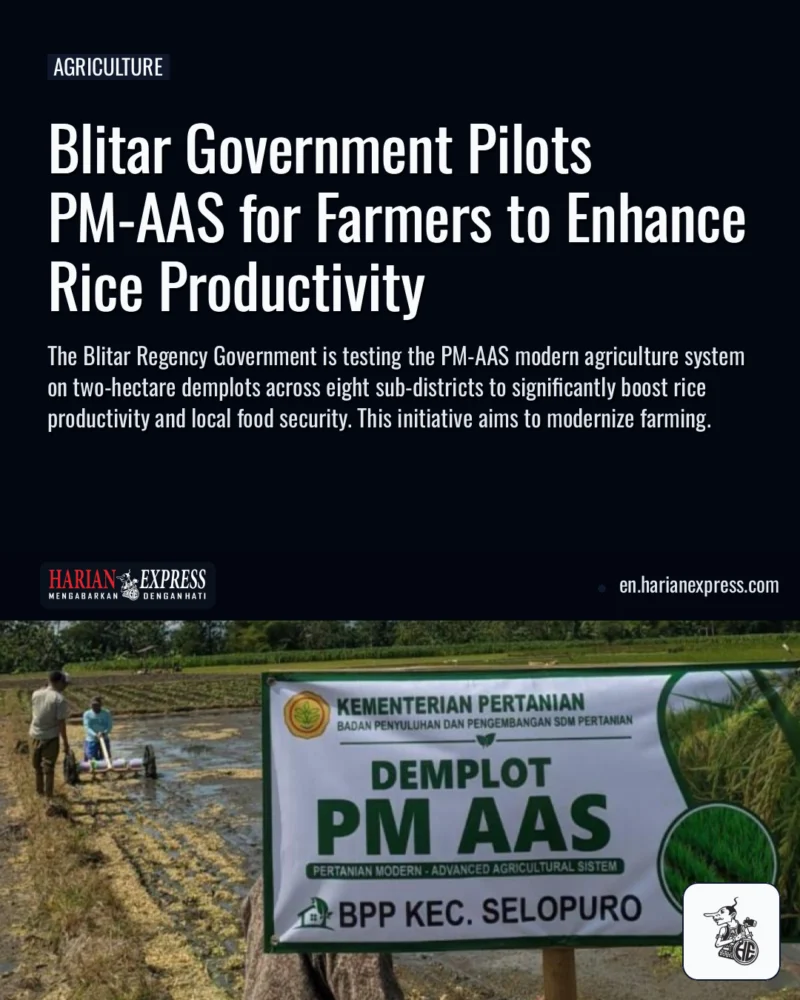
HARIANEXPRESS – The Blitar Regency Government in East Java is piloting the Pertanian Modern-Advanced Agriculture System (PM-AAS) for farmers. This initiative, implemented through the Food Security and Agriculture Office, aims to significantly increase rice productivity.
Demonstration plots, each spanning two hectares, have been established in eight sub-districts to showcase the new system. This effort is designed to strengthen regional food security.
Blitar Adopts Modern Farming Methods
Siswoyo Adi Prasetyo, Head of the Food Crops and Horticulture Facilities Division at the Blitar Regency Food Security and Agriculture Office, stated that the program was initiated by the Ministry of Agriculture.
Its primary goal is to encourage the modernization of the agricultural sector. The demplots serve as a direct educational tool for farmers before wider implementation.
“The technology applied is direct seed sowing with the jajar legowo system. The need for seeds and fertilizer is indeed greater, but the plant population increases, so the yield is also expected to be higher,” Siswoyo said.
The eight sub-districts chosen for the trial are Selopuro, Doko, Selorejo, Kanigoro, Sutojayan, Gandusari, Wlingi, and Talun, all located within Blitar Regency.
PM-AAS: A Leap from Conventional Farming
Unlike traditional methods that use transplanted seedlings, PM-AAS employs a direct seed sowing (tabela) system. This method utilizes a jajar legowo planting pattern.
Siswoyo explained that this system significantly boosts the plant population. Conventional methods typically yield 300 to 400 clumps per hectare, while PM-AAS has the potential to reach 800 to 1,000 clumps per hectare.
A key challenge for PM-AAS adoption is not land conditions, provided there is sufficient water. Instead, it lies in changing farmers’ mindsets and habits to embrace new technologies.
Support and Future Plans for Farmers
The local government is also optimizing support from Field Agricultural Extension Workers (PPL). These extension workers provide socialization, guidance, and demplot construction in each area.
“We are optimizing the role of PPL for socialization, assistance, and the development of demplots in each region,” he added.
Furthermore, the local government has proposed 203 hectares for the implementation of PM-AAS during the August-September 2026 planting season. Farmers participating in the program will receive support for production facilities, while initial planting tools can be self-made.
The Blitar Regency Government hopes the PM-AAS trial will improve rice productivity. They also envision it becoming a model for modern agricultural development to strengthen local food security.