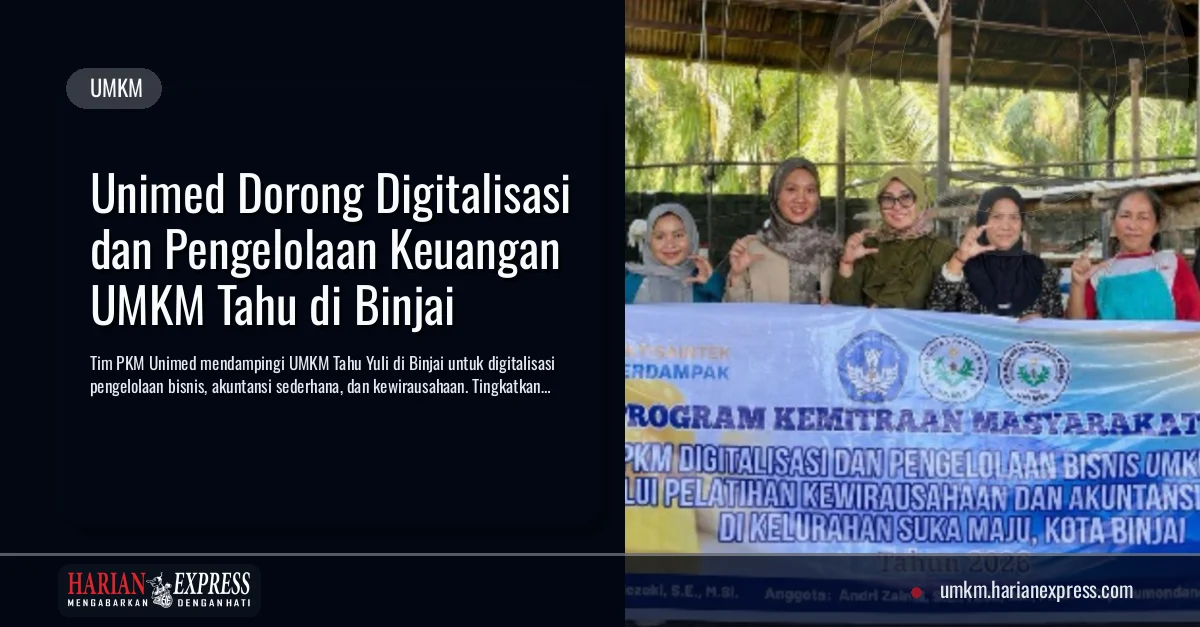
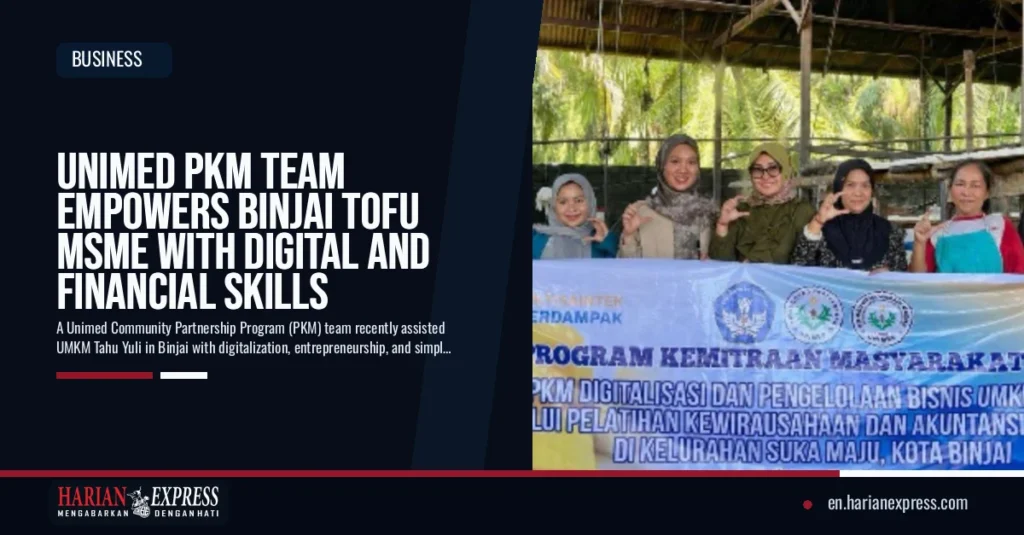
HARIANEXPRESS – A Community Partnership Program (PKM) team from Universitas Negeri Medan (Unimed) recently conducted an assistance program for UMKM Tahu Yuli in Suka Maju Village, Binjai City. The initiative, carried out on Tuesday, July 28, 2026, focused on digitalizing business management, providing entrepreneurship training, and implementing simple accounting practices. This effort aims to enhance business efficiency and ensure the sustainability of the tofu micro, small, and medium enterprise (MSME).
Unimed Team Supports Binjai Tofu MSME
The PKM program, led by Dr. Sri Rezeki, S.E., M.Si., along with members Andri Zainal, S.E., M.Si., Ak., Ph.D. and Tapi Rumondang Sari Siregar, S.E., M.Acc., leveraged their expertise in entrepreneurship, management accounting, cost control, Cost of Goods Sold (HPP) calculation, and basic bookkeeping.
The activity saw participation from Yuliana, the owner of UMKM Tahu Yuli, and all her employees involved in production and business management. Five students from Unimed’s Faculty of Economics management program also assisted in data collection, business record-keeping practice, and documentation.
Savitri Rahmadany, S.Pd., M.Li. from Unimed’s Research and Community Service Institute (LPPM) also accompanied the implementation of the PKM to ensure the activities aligned with the program’s objectives and the partner’s needs.
Initial Business Assessment and Challenges
Before delivering the training, the PKM team conducted a thorough mapping of the partner’s business conditions. This assessment covered production processes, raw material usage, operational costs, production volume, selling prices, financial recording patterns, and existing marketing systems.
The data collected served as the foundation for developing training materials and determining the most appropriate forms of assistance for the MSME’s specific characteristics. A significant issue identified was the unstructured financial record-keeping of the business.
Many income and expenditure transactions were still recorded manually or relied solely on memory. Additionally, business finances were not fully separated from household finances, making it difficult for the owner to ascertain actual profits.
Implementing Simple Accounting and Cost Calculation
To address these financial challenges, the team provided training on simple accounting principles. This included instruction on recording income and expenses, categorizing production costs, preparing basic profit and loss statements and cash flow, and separating business finances from personal finances.
The material was delivered practically, using transaction examples directly relevant to Tahu Yuli’s production activities. The partner also received guidance on independently calculating Cost of Goods Sold (HPP).
HPP calculation involved identifying costs such as soybean raw materials, labor, water, electricity or fuel, transportation, and other operational expenses. Through this calculation, the MSME can set more rational selling prices rather than solely relying on market prices.
Entrepreneurship Reinforcement and Digitalization
Beyond financial aspects, the PKM team strengthened the entrepreneurship skills of the owner and workers. Training topics covered simple business planning, cost control, operational management, identifying business opportunities and risks, and making decisions based on production and financial data.
Digitalization of business management was a core component of the program. The MSME was introduced to digital worksheets or simple spreadsheets for recording daily income, expenses, raw material quantities, production output, and sales.
The recording format was designed to be user-friendly, accessible via smartphones or available computers. The use of a digital system is expected to help the partner store business data more neatly and sustainably.
This organized data can then be utilized to evaluate cost changes, identify sales trends, calculate profits, and formulate production plans. In terms of marketing, the team introduced instant messaging applications, digital catalogs, and social media as tools for promotion and customer communication.
The partner received assistance in preparing product information, photos, prices, and order contact details for broader dissemination to consumers. Throughout the activities, the owner and workers actively participated in discussions, simulations, and practical recording exercises.
Participants also raised current challenges, particularly concerning fluctuating raw material prices, cost management, selling price determination, and marketing limitations.
Program Outcomes and Unimed’s Commitment
Through this program, UMKM Tahu Yuli is expected to consistently implement financial and production recording systems, independently calculate HPP, separate business finances from household finances, and leverage digital media to expand its market reach.
The PKM activity underscores Unimed’s commitment to bolstering MSMEs by applying simple, affordable, and community-relevant science and technology. This collaboration between lecturers, students, LPPM, business owners, and all workers is anticipated to foster more organized, efficient, adaptive, and sustainable MSME management.