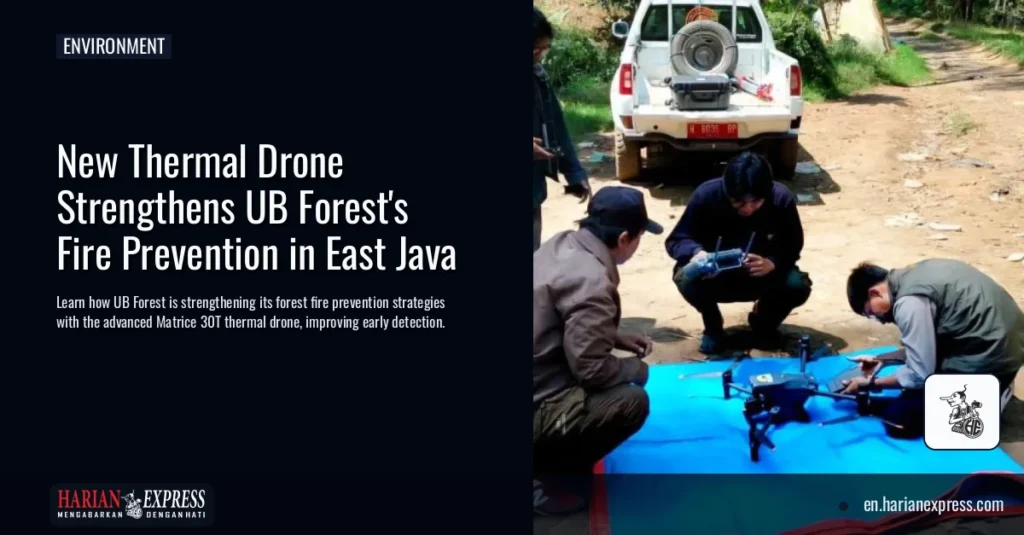
HARIANEXPRESS – UB Forest management in Malang, East Java, is significantly bolstering its efforts to prevent and manage forest fires by deploying a sophisticated Matrice 30T thermal drone. This advanced piece of technology is capable of identifying hotspots from the air, providing crucial early warnings around the vast forest area.
The introduction of this drone is a strategic move to help officers gather vital information about suspected fires quickly, even before any extensive ground operations are initiated. The new system represents a proactive approach to forest fire mitigation, especially as dry conditions intensify.
Boosting Early Detection Capabilities with Advanced Drones
Muhammad Yusuf, who serves as the Coordinator of Forest Area Protection and Monitoring at UB Forest, highlighted the immediate actions taken once a potential threat is identified. The drone’s ability to provide rapid insights is pivotal for swift intervention.
“If a hotspot is detected, we immediately inspect the site. Any fire found is promptly extinguished,” Yusuf stated.
This thermal drone forms an integral part of UB Forest management’s comprehensive strategy to prepare for and proactively prevent forest fires. The intensified dry season demands more rigorous and efficient monitoring, which the drone helps to facilitate.
Between August 25-27, 2026, the dedicated team utilized the thermal drone for monitoring the designated area. During these patrols, hotspots were successfully detected not only within UB Forest but also in areas immediately outside its boundaries, including along its border with the surrounding forest.
Yusuf conveyed that these aerial monitoring results remain a significant concern for the officers. There is a real risk that a detected fire could spread into UB Forest if not quickly addressed and brought under control.
Beyond technological solutions, the management also actively involves local farmers who work the land in protecting the forest area. This collaboration is formalized through a cooperation agreement (PKS).
Overcoming Limitations of Traditional Patrols
Rifqi Rahmat Hidayatullah, Coordinator of the Functional Position Group (KJF) for Education, Training, and Development at UB Forest’s Forest Area Management UPT, emphasized the drone’s role in expanding patrol coverage. He noted that traditional methods have inherent limitations.
“On-foot or motorcycle patrols have limited range,” Hidayatullah explained, underscoring the benefits of aerial surveillance.
The Matrice 30T thermal drone is specifically engineered with advanced sensors that can detect surface temperature variations. This crucial feature allows for precise identification of potential fire risks.
Should the drone identify a temperature that is higher than normal, officers can direct it for a more detailed inspection. The drone’s powerful zoom camera then allows for a closer look at the exact location.
Yulianto Muji Nugroho, a Technical Officer at the UB Forest Education Laboratory (PLP), provided further technical details about the drone’s operational capabilities. He explained that the drone can effectively monitor an area of approximately 10 hectares in a single flight.
Its maximum monitoring distance extends to approximately 500 meters, enabling a broad scope of surveillance. However, the drone also presents some operational constraints that must be considered.
“This thermal drone is helpful for detection, but its flight time is limited to around 30 minutes. Longer patrols require additional batteries and patrols twice a week,” Nugroho elaborated.
Due to these inherent limitations, the drone is primarily considered a valuable supporting tool for early detection. It complements, rather than fully replaces, the essential work performed by field patrols.
About UB Forest
UB Forest is an expansive educational forest, covering an area of 544.74 hectares. This significant natural asset is carefully managed by Universitas Brawijaya and is majestically situated on the slopes of Mount Arjuno in East Java.
Established in 2015, the forest area encompasses both production and protected zones. It serves as a vital site for a wide range of activities including multidisciplinary education, cutting-edge research, and various community engagements, making it a crucial resource for both environmental and academic purposes.