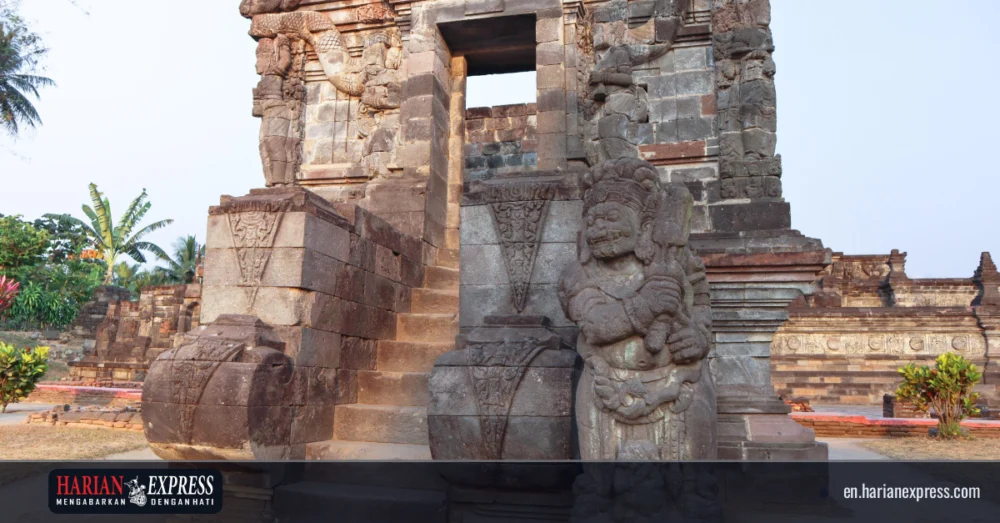
HARIANEXPRESS, BLITAR – The historical site of Candi Gedog in Blitar, East Java, preserves historical mysteries alongside traces of Thomas Stamford Raffles. This heritage location contains remnants of a Hindu civilization that dominated until the mid-16th century alongside an ancient Christian cemetery from the colonial era.
Vandalized Tombs and the Central Well
Unfortunately, the cultural heritage site currently faces a concerning condition due to ongoing vandalism. The ancient cemetery features gravestones without inscribed dates, though their tile patterns form clear religious symbols.
Unlike typical Islamic burial sites, this area does not feature any frangipani trees. Records show eight graves in the complex, five of which have suffered severe damage from irresponsible individuals.
Vandals pulled out the crosses, leaving only broken, sharp concrete blocks across the graves, including two children’s burial plots. Visitors can also spot a newly dug, square-shaped well nearby.
While the well suggests communal use, its placement directly amid the burial plots triggers worries over water contamination. A massive banyan tree also shelters the surrounding land.
The space beneath the giant tree resembles a public gathering spot during daylight hours. However, local residents believe mystical figures make appearances in the area once the sun goes down.
Raffles’ Journey and the Discovery of Candi Gedog
The connection between Thomas Stamford Raffles and Candi Gedog began after personal heartbreak. His wife, Olivia, passed away in late 1814 at the age of 43.
Olivia was laid to rest in Bogor with a poignant inscription carved on her monument:
“Tho fate severe hath bid us part, yet still forget me not.”
Seeking solace from his grief, Raffles embarked on extensive travels. In 1815, his journey brought him to the Blitar region.
Guides led Raffles through dense forests to visit ancient monuments previously overlooked by Dutch colonial authorities. Candi Gedog stood out as one of these remarkable sites.
In his travel records, Raffles described Candi Gedog as a brick structure crafted with exceptional artisan skill. He noted that stone comprised many of the temple’s elaborate ornaments.
Several sections of the building remained intact at the time, although the entrance base had begun to separate. Notably, his written documentation made no mention of the massive banyan tree.
Mount Kelud’s Eruption and Cultural Preservation
Roughly a century following Raffles’ expedition, Mount Kelud erupted on 19 Mei 1919, inflicting catastrophic destruction across the surrounding Blitar area. Experts believe this powerful volcanic event brought down the primary temple structure.
Despite standing at a modest elevation of 1.731 meter, Mount Kelud is notoriously brutal due to its sudden eruptions that discharge lethal flows of liquid rock. Alongside Mount Merapi, it ranks as the most hazardous volcano among the 127 active volcanoes in Indonesia.
Ongoing Security Concerns and Site Patrols
Modern threats to Candi Gedog stem directly from human misconduct. Wide gaps in the perimeter fence allow thieves to access the grounds freely without needing to sneak around.
Perpetrators break down and carry away carved stones to sell these valuable national cultural relics. Despite the quiet surroundings, authorities maintain regular surveillance across the precinct.
A police officer named Yomano conducts patrols across the heritage site. His watch helps protect the remaining ancient Kala statues and intricate stone carvings of female figures.