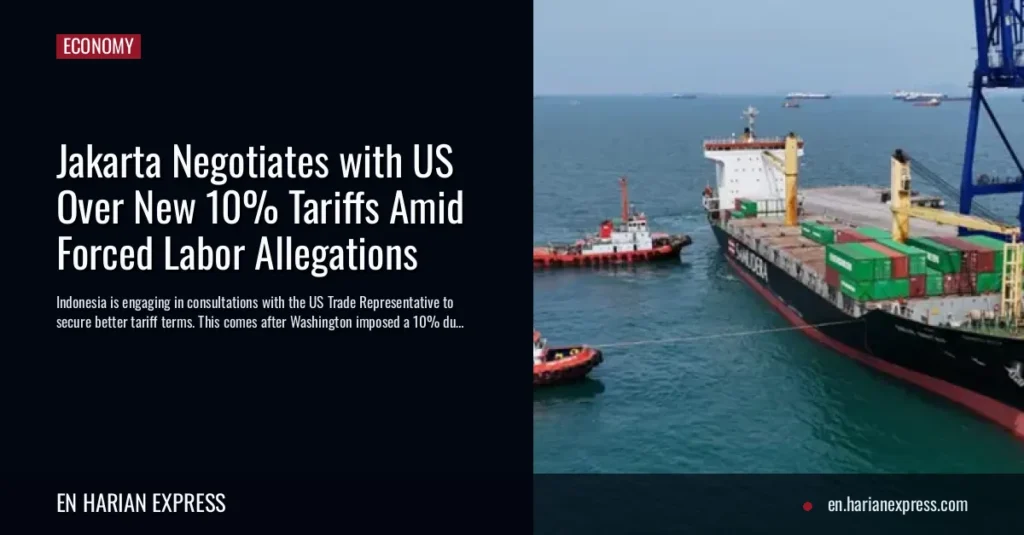
HARIANEXPRESS – Indonesia is actively pursuing more favorable tariff conditions from the United States after Washington levied a 10 percent duty on Indonesian imports. This new tariff was imposed on Friday (July 24) over alleged forced-labor violations, prompting Jakarta to seek more competitive trade terms. The country also faces the looming risk of additional tariffs tied to claims of heavy state subsidies causing structural overcapacity, further complicating trade relations.
The Indonesian government is engaging in active consultations with the U.S. Trade Representative (USTR) to achieve “the best and most competitive tariff.” This effort highlights Indonesia’s commitment to addressing trade concerns raised by the US. Jakarta aims to mitigate the economic impact of these new duties on its vital export sectors.
Indonesia’s Diplomatic Efforts to Address Trade Concerns
Haryo Limanseto, spokesperson for the Office of Coordinating Economy Minister, confirmed Indonesia’s ongoing discussions with the USTR on Friday. He indicated that Jakarta is working to secure an optimal tariff structure for its exports.
“The government is actively continuing consultations with the US Trade Representative (USTR) to obtain the best and most competitive tariff.”
Limanseto also acknowledged the USTR’s recognition of Indonesia’s commitment. Indonesia has actively worked to prevent and combat forced labor within global supply chains, establishing a regulatory framework to tackle the issue. He further stated that results from an investigation into the excess-capacity issue, based on information from the US side, are expected soon.
“We welcomed the USTR’s recognition that Indonesia has actively committed to preventing and combating forced labour in global supply chains and has a regulatory framework in place to address the issue.”
“Based on information from the US side, the results of the investigation into the excess-capacity issue will be issued soon.”
Details of the US Tariff Imposition
The new 10 percent tariff on Indonesian imports falls under Section 301 of the Trade Act of 1974. This trade tool was previously utilized by US President Donald Trump’s administration. The imposition followed the US Supreme Court’s decision in February, which struck down sweeping “reciprocal” tariffs from the previous year.
This move occurred on the same day that a temporary 10 percent global tariff, imposed under Section 122 of the Trade Act of 1974, reached its 150-day limit and expired. Under the Section 301 basis, the US also imposed a 12.5 percent tariff on imports from Australia, China (including Hong Kong), Singapore, and South Korea, citing failures to prevent goods made with forced labor from entering the American market. Indonesia, alongside Malaysia, Taiwan, and India, is subject to the additional 10 percent tariffs.
Beyond the forced-labor investigation, the Trump administration is pursuing another inquiry under Section 301. This separate investigation focuses on concerns about excess manufacturing capacity, involving Indonesia and 15 other economies. Jakarta had estimated in June that the final tariff burden on Indonesian goods exported to the United States could reach approximately 18 percent, combining the initial 10 percent for forced-labor concerns with an additional component for structural overcapacity.
Indonesia is now actively seeking to reduce this projected figure through negotiations with Washington. The government is also pressing for exclusions for key export products. Officials argue that Indonesia has already taken significant steps to address US concerns regarding forced labor.
Economic Impact and Industry Concerns
The US is one of Indonesia’s largest export markets and its primary source of non-oil and gas trade surplus. In the first five months of 2026, Southeast Asia’s largest economy recorded a trade surplus of about US$7 billion with the US, according to Statistics Indonesia (BPS) data. This makes favorable trade terms crucial for the nation’s economy.
Export-oriented manufacturers are expected to bear the brunt of the new tariff regime, especially those heavily reliant on the US market. Industries such as textiles, garments, and footwear are particularly exposed due to their labor-intensive nature and dependence on US buyers. Other significant export categories include electrical machinery and equipment, along with animal and vegetable fats and oils.
Shinta Kamdani, chairwoman of the Indonesian Employers Association (Apindo), expressed concerns about the prolonged uncertainty. She noted that this situation could significantly impact business decisions, particularly in labor-intensive sectors.
“Prolonged uncertainty would weigh on business decisions, particularly in labor-intensive sectors.”
Kamdani emphasized that the uncertainty extends beyond just the tariff level. Businesses are also concerned about policy predictability and certainty regarding implementation. Such unpredictability might lead companies to postpone production plans, capacity expansion, and new investments until the tariff structure becomes clearer. The impact will, however, vary across different commodities, with some products still under discussion for possible exclusion.
“For businesses, the uncertainty is not just about the tariff level, but also policy predictability and certainty over implementation.”
She urged Indonesia to maintain intensive economic diplomacy. This is vital to secure clarity on the exclusions currently under negotiation. Investors also consider the broader quality of an investment ecosystem, not just tariffs, when deciding where to relocate production, she added.
“Indonesia should maintain intensive economic diplomacy to secure clarity on the exclusions under negotiation.”
Broader Implications and Expert Opinions
Hasran, a researcher at the Center for Indonesian Policy Studies (CIPS), suggested that Indonesia might not necessarily benefit from the potentially lower tariff. This is because several competing exporters, including Bangladesh, India, Malaysia, Cambodia, and Pakistan, face the same rate. Indonesia still contends with higher logistics and trade-facilitation costs compared to these nations.
“Foreign direct investment (FDI) decisions are largely determined by the incremental capital-output ratio (ICOR), port infrastructure, the availability of raw and intermediate materials and whether a free-trade agreement existed.”
Rizal Taufikurahman, head of the Center of Macroeconomics and Finance at the Institute for Development of Economics and Finance (Indef), informed The Jakarta Post on Friday that the forced-labor issue could impact more than just Indonesia’s trade ties with the US. It could also affect the country’s standing in global markets.
While the US measure does not imply that all Indonesian products are linked to forced-labor concerns, Rizal suggested potential consequences. It could raise exporters’ compliance costs and diminish their competitiveness as buyers and investors tighten supply-chain audits and demand stricter labor standards and traceability.
Bilateral Agreements and Future Outlook
Indonesia hopes any resulting tariffs will be “favorable and competitive,” while also accommodating product exclusions agreed under the Agreement on Reciprocal Trade (ART). Jakarta and Washington signed the ART on Feb 19, just one day before the US Supreme Court invalidated the legal basis for a 19 percent tariff on Indonesian goods. The government had previously stated that the bilateral deal could stand independently. However, provisions tied to the now-invalidated tariff authority have created a legal snag, delaying its implementation and ratification.