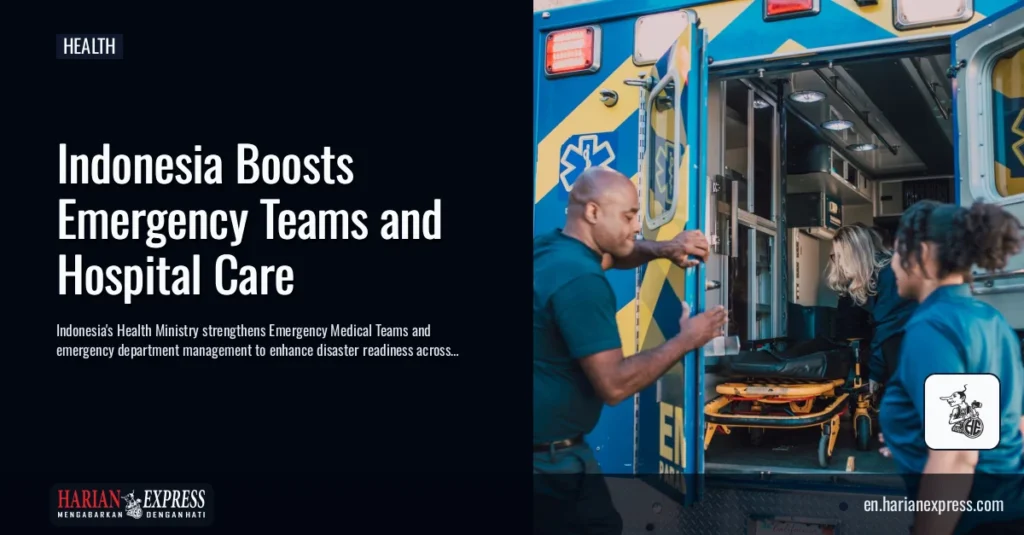
HARIANEXPRESS – Indonesia’s Ministry of Health is strengthening the standardization of Emergency Medical Teams (EMTs) and enhancing hospital emergency department management to boost disaster preparedness, (8/9/2026)
Health Minister Budi Gunadi Sadikin stated that this initiative aligns with Indonesia’s status as the country with the second-highest number of recorded disasters globally.
“Hence, we should have EMTs with WHO standards, from level 1 to level 2, distributed equally in regions and integrated with the accreditation criteria for regional public hospitals on every island,” Sadikin stated.
As of September 2026, the ministry recorded at least 52 natural disaster-triggered health crises across the country. In response, authorities have prepared 38,418 reserve health workers nationally and continue facilitating WHO-standard EMT certification, such as that achieved by the Muhammadiyah Disaster Management Center (MDMC).
The ministry is also reforming hospital emergency department management to eliminate internal bureaucratic delays for urgent patients. Key measures include revising emergency department residency training, centralizing hospital bed management, supplying basic medical equipment, and updating the diagnosis-related group (DRG) system under BPJS Kesehatan.
“We aim to reduce emergency patients’ waiting times as much as possible,” he added.
Indonesian Society of Emergency Physicians (PDEI) Chairperson Wishnu Pramudito welcomed the reform as a sign of progress in national healthcare services.
“We target our emergency department services to be on par with hospitals in major cities, such as New York or London, in 10 years,” he said.
Pramudito noted that structural reforms must address the severe shortage of emergency medicine specialists, noting the current count of 66 specialists falls far short of the required 1,034. He also underscored the importance of providing public and school first-aid education to save lives during critical early minutes of emergencies.