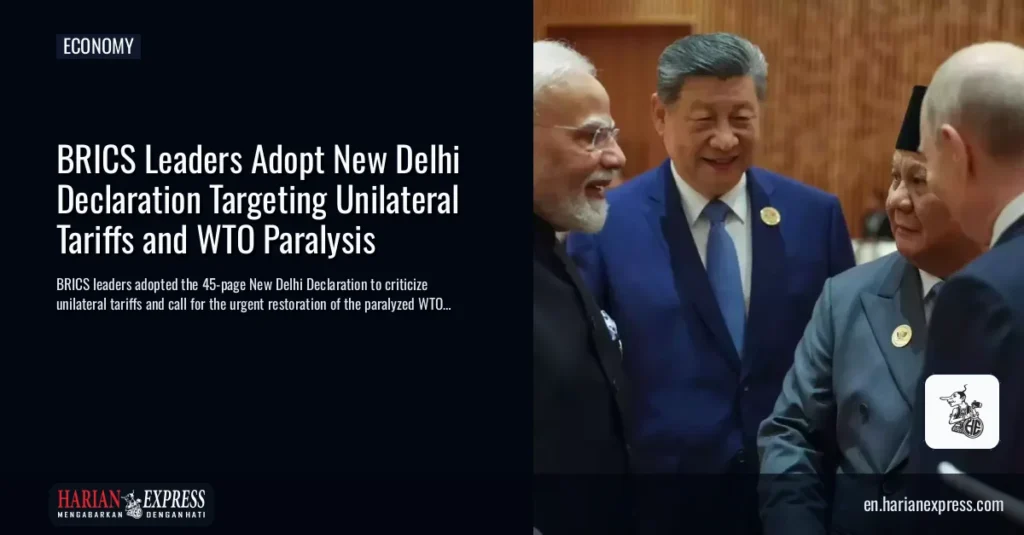
HARIANEXPRESS – BRICS member nations have voiced collective criticism against the implementation of unilateral tariffs, delivering an indirect critique toward United States President Donald Trump while demanding an overhaul of the stalled global trade dispute system. New Delhi hosted leaders of the bloc—including Indonesian President Prabowo Subianto—against the backdrop of escalating tariff volatility and armed conflicts late last week.
The China-backed grouping formally ratified a comprehensive draft titled “Deklarasi New Delhi” on Saturday. This 45-page document incorporates dedicated chapters assessing the current paralysis within the World Trade Organization (WTO) alongside unilateral tariff measures.
Growing Concerns Over Global Supply Chains and Unilateral Duties
Bloc members determined that the multilateral trading system has reached a defining crossroads. Serious concerns were raised regarding how tariff policies and non-tariff actions aggravate existing economic disparities and imperil global supply chain stability.
“Kami menyuarakan keprihatinan yang mendalam atas meningkatnya tarif dan tindakan non-tarif sepihak, yang mendistorsi perdagangan dan tidak sejalan dengan aturan WTO,”
The joint declaration highlighted these trade disruptions without explicitly naming Washington. Under the Trump 2.0 administration, double-digit duties have been levied against several BRICS nations individually, including Indonesia.
During previous exchanges, Trump pushed for duties reaching triple digits against China. Last year, he also warned of an additional 10% tariff penalty on countries pursuing policies branded as “non-Amerika”.
Moves across BRICS to trim dependency on the US dollar have sparked friction with Trump. As a newcomer to the association, Indonesia currently faces a 10% tariff on exports destined for Washington over allegations surrounding imported goods linked to forced labor.
Summit host India confronts an identical 10% tariff rate under similar justifications. Meanwhile, Russia was excluded from Trump’s tariff campaign after the White House determined that ongoing Western sanctions remain sufficient to restrict substantial trade.
The Impasse at the World Trade Organization
A primary focus of the summit revolved around the longstanding stalemate affecting the Geneva-based multilateral trade adjudicator. The bloc explicitly reaffirmed its stance on trade dispute mechanisms.
“sangat mengadvokasi pemulihan segera mekanisme penyelesaian sengketa WTO dua tingkat yang mengikat, yang dapat diakses, efektif, dan berfungsi penuh,”
BRICS leaders underscored that reactivating the appellate arm remains essential to revive “kepercayaan dan prediktabilitas” among member governments. The WTO appellate tribunal has stayed non-operational because Washington blocked appointments of new adjudicators over allegations of judicial overreach.
The appellate body is structured to operate with seven judges serving four-year mandates. Restoring these vacant judicial seats mandates a formal consensus among all WTO member states, including the United States.
“[Kami sangat mengadvokasi] … penunjukan anggota badan banding baru tanpa penundaan lebih lanjut,”
Prabowo Subianto Cautions Against Weaponizing Trade and Currency
The high-level discussions in New Delhi unfolded primarily behind closed doors. During the closed-door proceedings, President Prabowo Subianto asserted that “lembaga keuangan internasional juga harus berevolusi.”
“Perdagangan dan mata uang tidak boleh dijadikan senjata,”
Prabowo delivered the statement without singling out any specific country. Both Russian leader Vladimir Putin and Chinese President Xi Jinping were present inside the meeting room during his remarks.
Collectively, the BRICS coalition commands a formidable presence in the world economic landscape:
- BRICS represents 40% of the entire global economy.
- The alliance controls more than 25% of worldwide trade.
Initially founded by Brazil, Russia, India, China, and South Africa, the bloc enlarged its composition in 2024 by admitting Egypt, Ethiopia, Iran, and the United Arab Emirates. Indonesia officially secured its formal seat within the group in the following year.