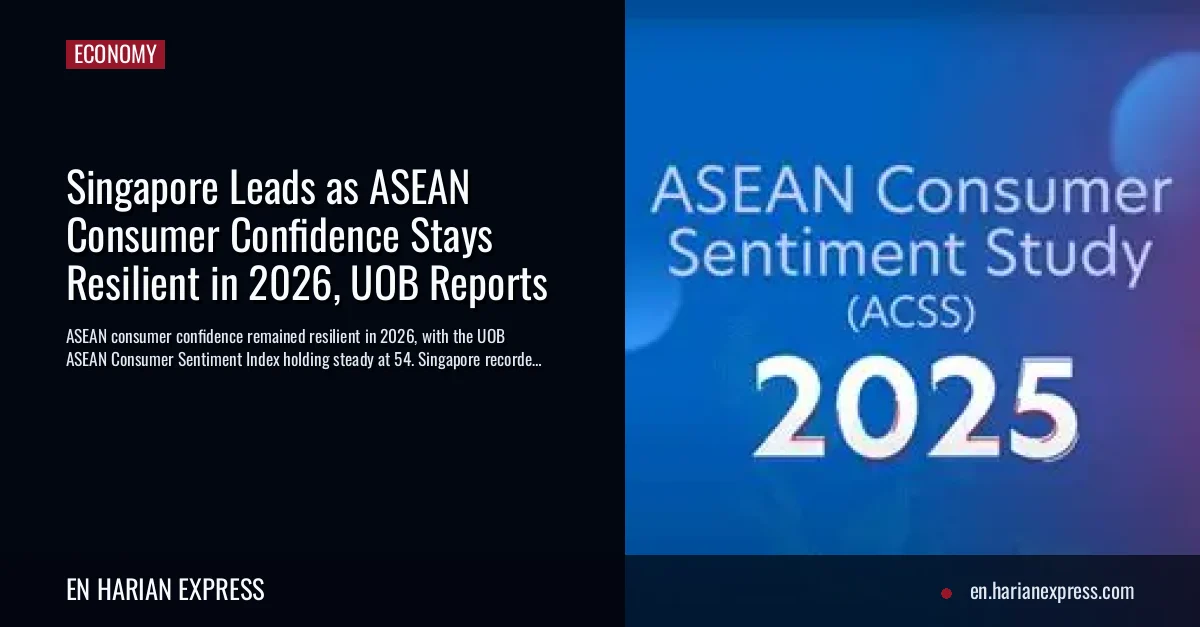
HARIANEXPRESS – Consumer confidence across the ASEAN region remained resilient in 2026, with the UOB ASEAN Consumer Sentiment Index holding steady at 54 points. This optimism prevailed despite various macroeconomic uncertainties, including geopolitical tensions in the Middle East and concerns over rising oil prices. Singapore notably recorded the strongest improvement in the region, with its country’s Index surging by nine points to 56.
The UOB ASEAN Consumer Sentiment Index, released on Friday, July 24, indicated that consumers generally felt optimistic about both the macroeconomic environment and their personal finances. The survey was conducted online from May to June 2026, encompassing 5,000 participants aged 18 to 65 years old across Indonesia, Malaysia, Singapore, Thailand, and Vietnam.
Singapore’s Significant Surge in Optimism
Singapore’s remarkable improvement in consumer sentiment was a key highlight of the 2026 study. The nation’s Index rose to 56 points from 47, reflecting uplifts across all macroeconomic and personal finance indicators. Positive perceptions of the current economy in Singapore rose significantly by 16 percentage points to 66 percent, while confidence in future economic performance increased by 13 percentage points to 63 percent.
This surge in confidence was attributed to strong growth performance in the first half of 2026, boosted by tailwinds from artificial intelligence-related demand. Additionally, government efforts to alleviate cost-of-living pressures and wealth effects from gains in equity markets further supported improved personal finance sentiments among Singaporeans.
Regional Divergence and Underlying Drivers
While regional sentiment held steady, consumer confidence diverged across ASEAN markets, reflecting varied economic conditions and consumer priorities. Stronger optimism about the macroeconomic environment played a crucial role in sustaining regional confidence, even as individuals remained cautious about their personal finances.
The macro sub-index, which measures optimism towards the broader economy, rose by three points to 61. However, the micro sub-index, reflecting personal financial sentiment, eased slightly to 51 from 52, indicating continued prudence among consumers.
Country-Specific Insights
- Vietnam: Despite a four-point decline, Vietnam retained the highest level of consumer sentiment at 63, making it the most optimistic market in the region. This score surpassed the regional average by nine points, supported by the country’s fast-growing economy, healthy economic fundamentals, and government measures cushioning price pressures. Foreign investors’ continued confidence in Vietnam’s medium-term prospects also played a role.
- Thailand: Thailand also recorded a strong year-on-year improvement, with its country’s Index increasing to 51 points from 47. This uplift contributed to the overall regional resilience.
- Indonesia: The Index for Indonesia fell below the neutral level of 50 during the 2026 survey. The country faced a more challenging external environment, characterized by currency pressures and global uncertainty.
- Malaysia: Malaysians generally expressed a more positive outlook. However, they harbored lingering concerns regarding household expenses, income security, and long-term financial commitments.
Nuanced Consumer Landscape
The findings from the UOB ASEAN Consumer Sentiment Study 2026 point to an increasingly nuanced consumer landscape. Across the region, optimism about the broader economic outlook coexists with a prudent approach towards personal finances. Consumers frequently cited concerns over increased household expenses, the prospects of pay cuts, and their ability to sustain long-term financial commitments.
This careful balancing act highlights how consumers are responding to economic shifts, policy measures, and financial pressures within a complex and fast-changing global environment. The index serves as a timely barometer of these responses across key ASEAN markets.
Despite the overall resilience observed, the region’s Consumer Confidence Index (CCI) in 2026 remained slightly below its 2025 level of 56. This small dip suggests that while optimism is present, a cautious approach persists as consumer confidence has not yet fully rebounded to pre-pandemic levels.
The increase in the macro sub-index, which reflects broader economic optimism, underscores positive sentiment regarding the wider economy. Conversely, the marginal softening of the micro sub-index signals that individuals maintain prudence when managing their personal finances.
Singapore’s Notable Surge in Confidence
Singapore notably experienced the most significant improvement across the ASEAN region, with its Consumer Confidence Index climbing nine points to reach 54. This uplift positioned Singaporean consumers as distinctly more optimistic about economic growth, their personal finances, and future job prospects.
Several factors contributed to this positive shift in Singapore. Easing inflationary pressures, coupled with a robust labor market, played a crucial role. Government support initiatives, such as the Assurance Package, further bolstered consumer confidence.
Significantly, Singapore led the region with the highest percentage of consumers, 37 percent, anticipating an increase in their discretionary spending in 2026. This highlights a stronger sense of financial security and willingness to spend among its population compared to other ASEAN nations.
Discretionary Spending Trends Across ASEAN
Despite the generally resilient sentiment, ASEAN consumers as a whole continue to exercise prudence in their spending habits. Only 27 percent of consumers region-wide expect to increase their discretionary spending in 2026, marking a five-percentage-point decrease from 32 percent in 2025.
This trend indicates a persistent cautiousness among consumers when it comes to non-essential expenditures. Many are prioritizing financial stability over lavish spending.
While Singapore led with 37 percent of its consumers planning to increase discretionary spending, Vietnam followed closely at 36 percent. Thailand saw 26 percent of its consumers expecting an increase, with Malaysia at 24 percent and Indonesia at 19 percent, illustrating varying levels of spending confidence across the bloc.
The top priorities for discretionary spending have also seen a shift. In 2026, consumers primarily focused on travel, dining out, and shopping for non-essentials. This differs from 2025, when travel, health and wellness, and home renovation were the leading categories.
This reprioritization suggests a return to experiences and leisure activities while still reflecting a mindful approach to overall spending. The shift indicates a cautious re-engagement with social and recreational activities.
The overall data suggests that despite positive economic indicators, many consumers across ASEAN are still prioritizing savings and debt repayment. This cautious approach is favored over increasing discretionary spending, reflecting a learned prudence from recent economic uncertainties.
Concluding Insights from the UOB Study
The UOB ASEAN Consumer Sentiment Study 2026 provides a comprehensive look into the complex sentiments prevailing across Southeast Asia. It highlights a region marked by overall resilience and a delicate balance between economic optimism and personal financial caution.
The diverse responses from individual countries underscore the varied economic realities and policy impacts within ASEAN. This makes the study an invaluable resource for understanding the regional consumer landscape.