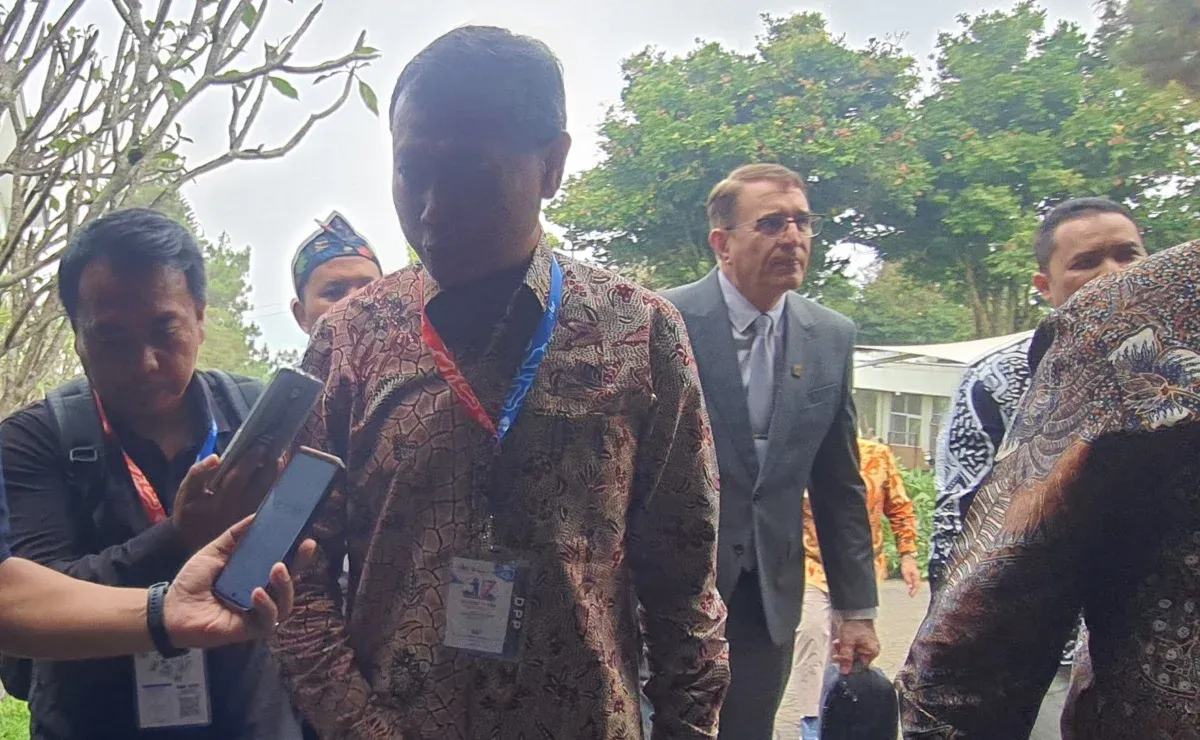
HARIANEXPRESS, BANDUNG – The 17th National Gathering (Silatnas) of the Indonesian Islamic Business Forum (IIBF) at Lembang Asri Resort, West Bandung Regency, held on August 20–22, 2026, became a stage for critical reflection on the national economic paradox, Thursday (8/20/2026).
The forum highlighted the glaring gap between the optimism of macro indicators and the harsh reality at the grassroots level. Although economic growth figures show promising performance, people’s purchasing power is uneven, and micro, small, and medium enterprises (MSMEs) continue to face heavy pressure.
Under the theme “Defend Indonesia, Buy Indonesian Products,” this annual event marking IIBF’s 17th anniversary aims to voice the pulse of the real economy directly from business practitioners. The organization seeks to bridge information so that real issues on the ground can be heard by policymakers.
Economic Paradox: Brilliant Macro Figures, Squeezed Grassroots Reality
Statistically, the national economy appears to be moving forward solidly. Macro indicators show stable economic growth above 5 percent, supported by household consumption growth of 5.06 percent in the second quarter of 2026.
The digital transaction sector also recorded a surge in public shopping activity by up to 36.85 percent year-on-year. The restaurant and hotel industry grew by 6.47 percent, while the transportation and communication sector rose by 5.71 percent, indicating support for mobility and recreation.
However, behind these positive figures, there is an anomaly at the lower levels. The reality on the ground presents a contrasting picture, where public purchasing power remains uneven and household savings are depleting.
MSME actors continue to face increasingly heavy pressure. This phenomenon became the main focus of discussion at the 17th IIBF Silatnas.
Liquidity Gap: Large Corporations Soar, MSMEs Squeezed
IIBF President, Heppy Trenggono, highlighted the pergence or gap between macroeconomic growth and the real conditions of business practitioners at the lower levels. He emphasized that high consumption growth figures do not always reflect a healthy increase in purchasing power across all layers of society.
“People are indeed still shopping, but we need to see where the source of financing for that consumption comes from and which business sectors are enjoying the money circulation,” said Heppy on the sidelines of the Silatnas.
An analysis of the national financing structure reveals significant inequality. While overall bank credit grew by 12.67 percent and investment credit surged by 24.90 percent, most of this liquidity was absorbed by the large corporate sector.
Conversely, the portion of bank credit channeled to the MSME sector was recorded at only 0.12 percent. This condition is exacerbated by the increasingly concerning decline in the savings of the lower-middle class.
“A dangerous phenomenon is that consumption is rising, but at the lower level, savings are decreasing; people’s savings are heading toward zero,” Heppy revealed.
This indicates that public consumption is being supported by the reduction of savings or consumptive financing, rather than a sustainable increase in income. On the ground, this situation has begun to cause an increase in bad debt issues felt by small business practitioners.
Heppy also compared public sensitivity regarding business scale. MSMEs that close often go unnoticed due to the fragmented nature of the industry.
“Nobody knows when an MSME closes down; but when Sritex closes, the whole of Indonesia knows. Yet, thousands of MSMEs falling at the grassroots level have a massive cumulative impact on national economic stability,” he said.
The Role of IIBF as a “National Economic Sensor” and the “Buy Indonesian” Movement
Amid economic challenges, IIBF is committed to remaining independent and not involved in practical politics. Heppy Trenggono stated that his organization will always maintain its objectivity as a strategic development partner for the government.
“IIBF will never be a volunteer for anyone competing, but IIBF will always be a development partner to the government by providing honest input,” Heppy asserted.
He also urged IIBF cadres to treat economic criticism as constructive thought contributions based on real data, rather than berating the government. In this context, IIBF plays its role as a “national economic sensor.”
The organization strives to be an information bridge so that real problems at the lower levels, which are often reduced in macro reports, can be heard directly by policymakers. As a concrete step, the “Buy Indonesian” movement continues to be accelerated by IIBF.
This movement is a macroeconomic strategy to strengthen domestic supply chains, not merely a ceremonial campaign. By encouraging national entrepreneurs to prioritize products from their fellow countrymen, money circulation is expected to be retained domestically, resulting in a more equitable redistribution of wealth.
Reconstruction of Entrepreneurial Character: Solutions Amid the Wave of Layoffs
IIBF’s main strength in facing global and national economic uncertainty lies in its unique coaching methodology. The Chairman of the Organizing Committee for the 17th IIBF Silatnas, Hanum Sujana, explained that IIBF differs from other business associations due to its focus on building the character of business practitioners.
“We focus on building the entrepreneur. Because a business will not outpace the growth of its businessman. If the businessman grows, the business will also grow,” Hanum explained.
IIBF provides mentoring to its members spread from Aceh to Sulawesi, with its strongest bases in East Java and Lampung. They implement a coaching ecosystem based on five support systems:
-
Family (Family Support)
-
Business Mentor
-
Spiritual Mentor
-
Peers
-
Mastermind Group
This holistic approach has proven capable of helping members resolve their fundamental issues. Hanum revealed that many business practitioners who joined IIBF while entangled in massive debt—even up to hundreds of billions of rupiahs—have successfully bounced back.
They restructured their businesses and settled obligations through mindset-change guidance and the support of a solid ecosystem network. This collaborative step is considered highly urgent, especially at the regional level.
The Chairman of IIBF’s West Java Regional Representative Council (DPW), Jaja Mujahid, revealed that entrepreneurial interest in joining IIBF has increased significantly amid the economic slowdown and the wave of layoffs. He noted that the main obstacles for members vary, ranging from marketing issues and capital limitations to demands for production efficiency.
“The main obstacles currently faced by members are highly perse, ranging from marketing issues and capital limitations to demands for production efficiency,” Jaja said.
Jaja invited business practitioners not to remain idle, but to actively seek collective solutions through community networks. He emphasized the importance of gathering to transfer energy and ideas amid the economic slowdown.
“When the economy is slowing down, do not remain silent. Gathering becomes a solution because there is a transfer of energy and ideas. Step out of your comfort zone; let’s discuss the way out,” added Jaja.
In West Java, routine coaching programs are held every quarter on a voluntary and community basis without membership fees. The materials delivered cover financial literacy, distribution management (how to be delivery), and business mastery.
Toward an Institutionalized Sustainable Organization
Entering its 17th year, IIBF has a transformational vision toward an Institutional Great Organization (IGO). This transformation aims to build a modern organizational structure that is independent, well-organized, and possesses a measurable cadre coaching methodology.
The organization wants to no longer rely on the figureheads of its founders. With institutionalized governance, IIBF plans to expand its office representation network across various regions in Indonesia, as well as open international representations.
This expansive step is intended so that the presence of IIBF cadres can create a broader, more concrete, and structured socio-economic impact. Ultimately, for IIBF, true economic growth must be translatable into welfare that is directly felt by Indonesian families.
This also includes strengthening public purchasing power, rescuing MSMEs from bankruptcy, and restarting the wheels of the economy from the nation’s grassroots level.