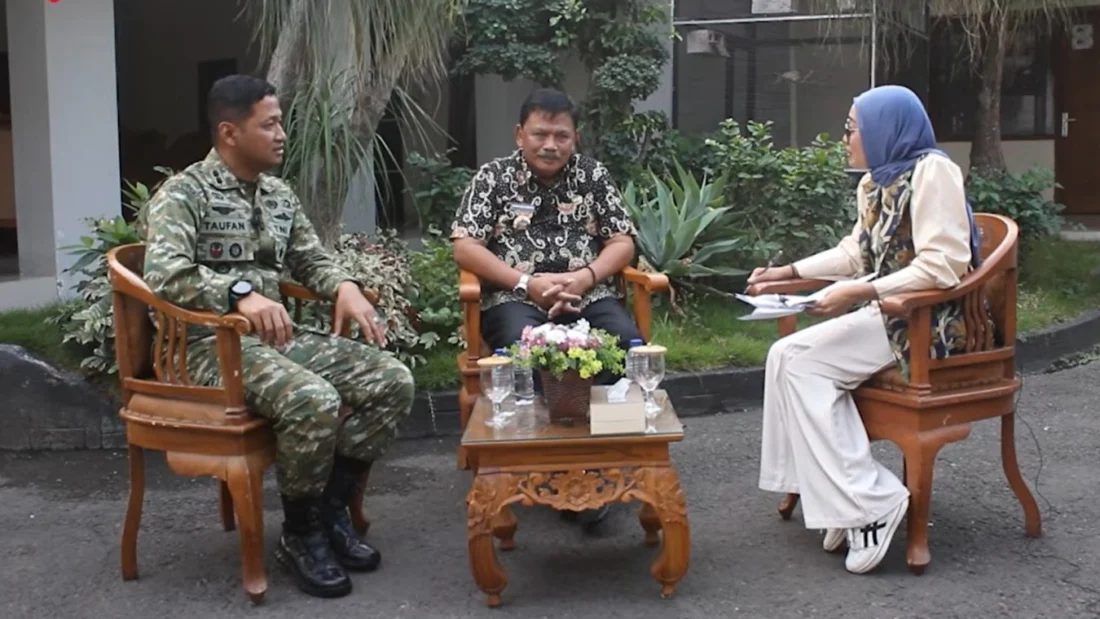

HARIANEXPRESS – Nganjuk Regency is demonstrating a proactive approach to development amidst pressing fiscal challenges. Despite efficiency measures impacting regional development budgets in 2026, various sectors continue to progress through strengthened cross-sector collaboration. This resilience is particularly evident through the synergy between the local government and the Indonesian Army (TNI AD) through Kodim 0810/Nganjuk.
The TNI’s involvement, under the leadership of Letkol Arh M. Taufan Yuda Bakti, extends beyond merely supporting development activities; it focuses on a territorial guidance approach that prioritizes community needs. Letkol Arh M. Taufan Yuda Bakti took command of Kodim 0810/Nganjuk on July 2, 2025.
When Budgets Are Limited, Collaboration Becomes Strength
The year 2026 presents significant fiscal hurdles for many regions, including Nganjuk. Budget adjustments have necessitated various strategies from the local government to ensure priority programs remain on track. However, fiscal constraints have not deterred development efforts.
Through robust collaboration among the local government, TNI AD, and community elements, essential public needs are being addressed effectively. This territorial development perspective emphasizes that success is determined not just by budget size, but by the ability to understand community needs, foster communication, and jointly implement solutions. This approach is observable across various programs in Nganjuk Regency.
Maintaining Nganjuk as a Food Barn
As a key producer of agricultural commodities like red onions, corn, and rice, Nganjuk places a strong emphasis on food security. TNI AD, through its network of Babinsa (village supervisory non-commissioned officers), plays a vital role in supporting agricultural stability, ensuring farmers’ needs are met from production to distribution.
Support includes ensuring the availability of seeds and fertilizers for optimal planting seasons. Efforts are also made to stabilize agricultural product prices, such as keeping paddy prices between Rp6,500 and Rp8,000 per kilogram, to ensure fair economic returns for farmers and maintain food price balance for consumers.
From Rainfed Fields to Productive Agriculture
In certain Nganjuk areas, water availability remains a primary agricultural challenge. Programs for constructing bore wells and pumping systems are transforming rainfed agricultural lands. One such initiative is in Ngeluyu and Genjeng villages.
With improved irrigation, approximately 9 hectares of land, which previously yielded only two harvests annually, now have the potential for three to four harvests. This not only boosts production but also provides farmers with planting certainty, reduces crop failure risks, and encourages younger generations to see agriculture as a promising sector.
Garuda Pioneer Bridge, Opening Paths for Village Economies
Beyond food security, improving access has been another persistent challenge for the community. Limited connecting infrastructure in some areas has hampered economic activity, education, and general mobility. The Garuda Pioneer Bridge program is addressing these connectivity needs.
Out of 11 planned bridges, 10 have been completed, with one still under construction. This initiative proves that infrastructure development doesn’t always require massive projects. A simple bridge connecting two areas can significantly impact community life.
For instance, the 60-meter Bagor Wetan Bridge links Sukomoro and Rejoso sub-districts, serving as a crucial route for community activities and agricultural product distribution. Elsewhere, shorter bridges have created immense social benefits. Previously, residents had to navigate difficult paths, descend four meters into a river, or use risky bamboo bridges. During the rainy season, people faced detours of up to four kilometers. Now, access is dramatically improved; children can easily reach school, farmers can transport produce more efficiently, and local economic activities flow more smoothly.
TNI Manunggal Air, Meeting Basic Community Needs
Access to clean water is a fundamental requirement for a good quality of life. For many years, villages like Klodan and Kepel in Ngetos sub-district struggled with clean water scarcity. The TNI Manunggal Air program has implemented a pipanization network to address this vital need.
With pipe networks spanning approximately 4 kilometers and 3 kilometers in challenging terrain, clean water now reaches about 1,200 people. For these communities, water is not just a utility; it directly impacts family health, household activities, and overall daily life. This program exemplifies how TNI AD’s territorial approach directly touches the most basic needs of the population.
Housing Renovation and Efficient Concepts Providing Added Value
In addition to clean water, improving residential quality through the Unfit for Habitation Homes (RTLH) program is another focus. With a budget of approximately Rp20 million per house, the program achieves optimal construction quality by involving TNI personnel in the labor. This allows more of the allocated funds to be used for building materials.
This approach highlights efficiency in community-based development. It aims not only to construct houses but to provide truly decent living spaces for those in need.
Development Impact Visible in Economic Growth
These various community-level interventions contribute to broader regional economic dynamics. Increased agricultural productivity, improved transportation access, and stable access to basic necessities are factors supporting local economic activity. Nganjuk Regency’s economic data for Semester I 2026 shows a 6.1 percent economic growth, with a 6.25 percent growth in Q2.
The Regional Gross Domestic Product (PDRB) reached approximately Rp40 trillion, and per capita income was around Rp35 million per year. These figures indicate that development initiatives directly addressing community needs have a ripple effect on economic activity. When agricultural produce is easily distributed, community access expands, and basic needs are met, the local economy thrives.
Territorial Guidance, Building Closeness with the People
For TNI AD, successful regional development is not solely measured by the number of infrastructures built. Rather, success is measured by the direct benefits felt by the community. The concept of territorial guidance establishes closeness between the TNI and the people as its core foundation.
Through communication, assistance, and collaborative work with various parties, TNI AD strives to be part of the solution to community problems. In Nganjuk, the synergy between Kodim 0810/Nganjuk and the local government demonstrates how collaboration can be a powerful force when facing limitations.
Nganjuk and the Model of Village-Level Development Synergy
Nganjuk’s experience illustrates that development does not always depend on extensive resources. With effective coordination, accurate needs assessment, and a spirit of mutual cooperation, limitations can be transformed into opportunities. From farmers’ fields to village roads, from water supply to community housing, every program shares a common goal: to enhance the quality of life for the community.
Bridges connecting regions, water flowing into homes, and increasingly productive agricultural lands symbolize that development is not just about statistics but about tangible changes in people’s lives. Through the spirit of TNI-Rakyat unity, Nganjuk exemplifies how development can continuously move forward when the local government and TNI AD work together towards a common direction. It is not just about building infrastructure, but about building hope.