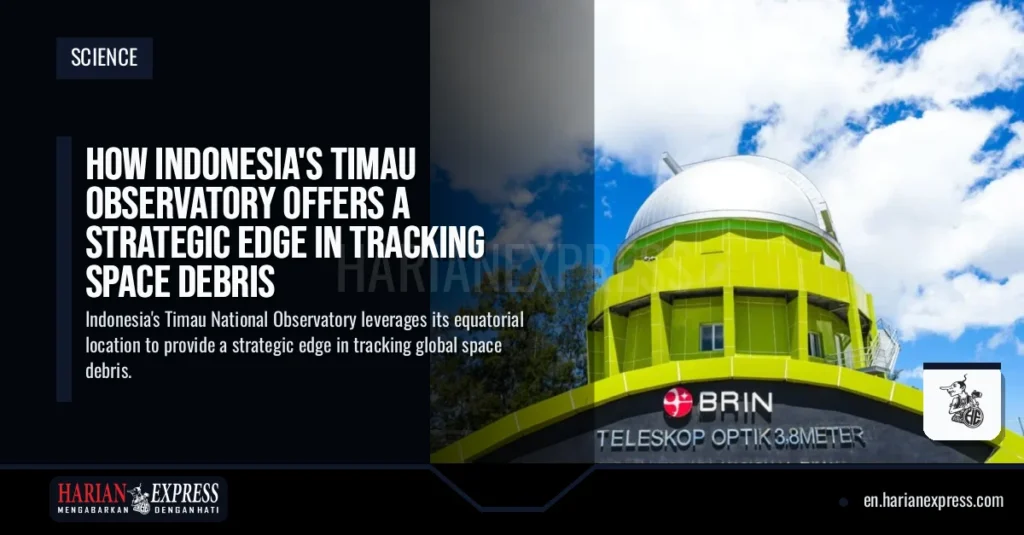
HARIANEXPRESS – The Timau National Observatory in East Nusa Tenggara (NTT) is positioning Indonesia as a major player in tracking global space debris. Managed by the National Research and Innovation Agency (BRIN), the facility leverages its strategic equatorial location to offer unparalleled views of the night sky.
Geographic Edge in the Southern Hemisphere
BRIN Space Research Center researcher Andre Pandie discussed the facility’s advantages during an online astronomy discussion on Friday. He explained that being situated near the equator grants astronomers a much clearer, direct view of orbiting objects.
Apart from its latitude, the Timau National Observatory offers a wide field of view because of its Southern Hemisphere location. This unique positioning avoids the atmospheric distortion commonly faced by European observatories.
Clear Views Above the Equator
Pandie noted that observations from Europe require telescope light to travel through nearly twice as much atmosphere. He explained how this affects the view of communications systems in space.
“Geostationary satellites, such as TV and communications satellites, line up directly above the equator. From Europe, these satellites appear low on the horizon,”
“In Indonesia, that line of satellites passes almost directly overhead, making them much easier to observe,”
Global Partnerships for Orbital Safety
The observatory operates a 3.8-meter giant telescope to monitor space junk. This technology enables the facility to perform cross-observations with international institutions.
The facility coordinates its tracking activities with Switzerland’s Zimmerwald Observatory. Such intercontinental cooperation is essential because night falls at different times around the world.
Continuous tracking is necessary to monitor satellites without any interruption. Pandie hopes the project will establish a reliable, independent data catalog for orbital safety.
Ultimately, this facility represents Indonesia’s concrete contribution to global space security through international collaboration.