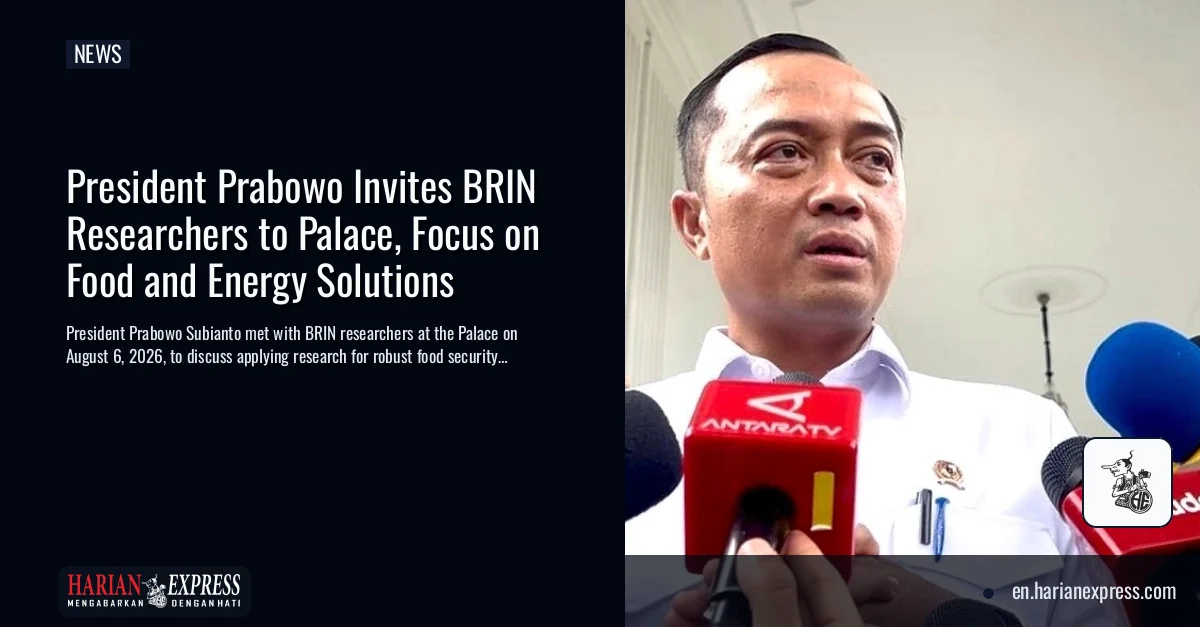
HARIANEXPRESS – President Prabowo Subianto recently invited several researchers from the National Research and Innovation Agency (BRIN) to the Presidential Palace in Jakarta on Thursday, August 6, 2026.
The crucial meeting aimed to explore how research outcomes can be effectively utilized to strengthen national food security, achieve energy independence, and resolve various issues confronting society.
Minister of State Secretary Prasetyo Hadi conveyed that BRIN researchers were slated to present a range of innovations capable of supporting the government’s priority programs. The government’s objective is to ensure that national research findings transcend academic publications, translating instead into technologies and policies that offer direct benefits to the community.
Strategic Focus on Food and Energy
Discussions during the meeting were primarily directed towards several strategic sectors, particularly food and energy. Beyond these core areas, the government also expressed interest in innovations related to effective waste management and the utilization of solar energy for water transportation.
One technology that garnered specific attention was the implementation of solar panels as a power source for boats. This innovation is perceived to hold significant potential for reducing the reliance of coastal communities on fossil fuels, simultaneously expanding the application of clean energy in the maritime transport sector.
Addressing Environmental Challenges
In the realm of environmental management, research findings concerning waste processing are anticipated to be applied to tackle the pervasive problem of waste accumulation across various regions. The government had previously advocated for the development of waste-to-energy technologies as an integral part of an integrated approach to environmental problem-solving.
The President’s engagement with BRIN researchers underscores the government’s commitment to fortifying the connection between research, policy, and the needs of society. The aspiration is for research to not only yield academic discoveries but also to produce deployable, affordable technologies tailored to Indonesia’s social and geographical conditions.
Driving Applied Research and National Programs
This initiative aligns with the government’s broader policy of encouraging the involvement of research institutions and universities in the advancement of new and renewable energy. In March 2026, the government urged academic circles to expedite research and studies on solar panels and solar power plants, marking them as key components of the national energy transition agenda.
The reinforcement of applied research is critical as Indonesia faces considerable challenges in maintaining food availability, diminishing dependence on imported energy, and managing waste effectively. The government hopes that collaborative efforts among ministries, BRIN, higher education institutions, businesses, and local governments will accelerate the adoption of these innovations.
By hosting this meeting at the Palace, the government firmly establishes science as a foundational pillar in the formulation of national strategic programs. The ultimate success of these agendas will largely hinge on the government’s ability to link research outcomes with essential elements such as funding, regulatory frameworks, production processes, and the practical implementation of technology within society.