HARIANEXPRESS – Papua boasts extraordinary biodiversity, with its tropical rainforests serving as a vital habitat for unique and rare species like birds of paradise and tree kangaroos. These extensive forests also play a crucial role in sustaining the lives of local communities across the region.
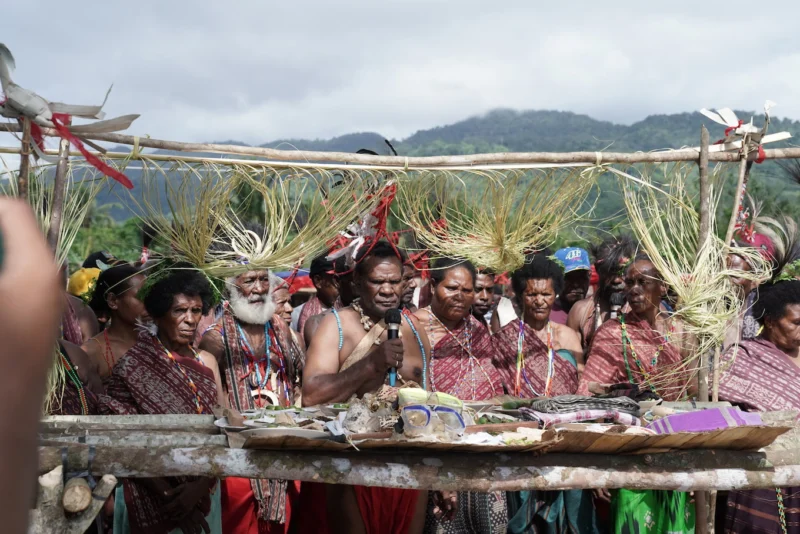
Among these communities are the indigenous Moi people, a prominent Papuan tribe inhabiting significant portions of Sorong district and Sorong city in Southwest Papua province. The Moi people predominantly reside in the Makbon sub-district, with their traditional territory extending across approximately 400 thousand hectares of land.
The Moi Tribe’s Deep Connection to Forests
The Moi tribe consists of seven sub-tribes: Moi Kelim, Moi Abun That, Moi Abun Jhi, Moi Salkma, Moi Klabra, Moi Lemas, and Moi Maya. For the Moi, forests are not just natural resources but an integral part of their existence.
Spenger Malasamuk, head of the Malaumkarta Raya Customary Council, emphasized that forests and humans are inseparable. The Moi people rely on these forests for food and other essential resources, which support their families’ economic needs.
“For us Papuans, especially the Moi indigenous community who live in the Makbon coastal area, Sorong district, forests are a source of life,” Malasamuk stated.
Traditional Forest Management: Clan Mapping System
A distinctive aspect of the Moi tribe is their unique forest management concept, which is rooted in a mapping system specific to each clan within the Malaumkarta village area, Makbon sub-district. This concept represents a cherished cultural heritage that continues to guide forest management practices in the region.
The mapping system helps minimize conflicts between clans within the Moi tribe regarding resource utilization. Each clan’s access to forest resources is determined by this mapping, ensuring they can gather what they need for their families without encroaching on others’ territories.
In Malaumkarta village, the clans recognized with the right to manage the forest based on this traditional mapping include:
- Kalami Kinipelik
- Kalami Tiloke
- Kalami Matiligek
- Malasamuk
- Magablo Lingsuok
- Mubalen
- Sapisa
- Su
- Salamala
- Ulimpa
- Magablo pesisir
- Do
The ‘Egek’ Culture: A Wisdom for Renewal
Another crucial cultural system for forest preservation in Papua is the ‘egek’ culture. Egek embodies the Moi tribe’s local wisdom for safeguarding their clans’ traditional forest areas, which are viewed as their fundamental source of life.
This cultural practice is a strategic method employed by the Moi people to conserve nature, ensuring that the community’s needs can be met sustainably. Passed down through generations, ‘egek’ provides a vital opportunity for nature to renew and restore itself before its resources are harvested again.
During a specified period, customary law prohibits the community from extracting forest products. Philosophically, the Moi tribe understands that forests and land are their lifeline, reflecting their profound dependence on forest wealth for their sustenance.
Government Support for Indigenous Rights and Forests
Torianus Kalami, an intellectual from the Moi tribe, highlighted the critical need for government support in protecting the Moi people through appropriate regulations. Such measures are vital to safeguard the rights of indigenous communities and their forests, while also allowing them to utilize these resources wisely and proportionally.
“We need government regulations to ensure that protection for indigenous peoples is fulfilled,” Kalami asserted.
While the Southwest Papua provincial government has yet to issue specific regulations for indigenous protection, the Sorong district has implemented Regional Regulation Number 10 of 2017. This regulation specifically concerns the Recognition and Protection of the Moi Tribe Indigenous Community.
Agustinus Asem, Head of the Sorong District Environment Office, affirmed that this regional regulation signifies the local government’s recognition of the Moi indigenous people as the primary owners of the land and forests in their area. This framework also enables indigenous peoples to actively participate in nature preservation, securing resources for future generations.
Kalami further urged the Sorong district government to promptly issue derivative regulations of the regional regulation. These additional regulations would provide more detailed guidance on mapping indigenous territories and other matters crucial to indigenous communities’ interests, forming a basis for mitigating issues in Papua’s forests.
Currently, the Sorong district government is in the process of forming community groups that will contribute to nature preservation efforts. This initiative underscores that forest protection is a shared duty, requiring active involvement from both the government and indigenous communities.