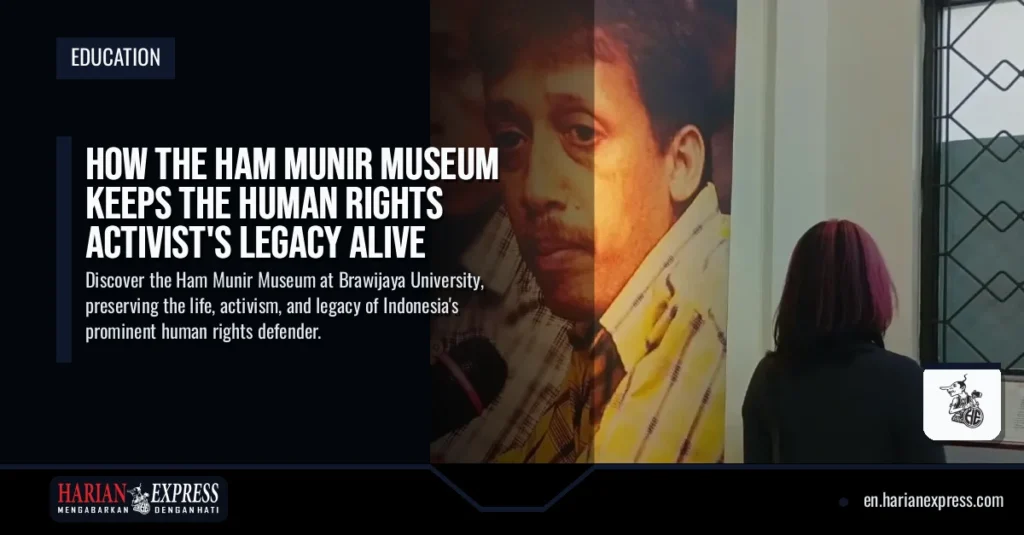
HARIANEXPRESS – More than two decades after Munir Said Thalib passed away, his remarkable journey remains preserved inside a university building located in Malang, East Java. The Ham Munir Museum sits proudly at Brawijaya University’s Faculty of Law to showcase the life and activism of one of Indonesia’s leading human rights defenders.
Opened in August 2024, the educational space offers visitors a detailed, chronological account of Munir’s life story. The facility details everything from his early childhood and student years to the major cases he handled and his final hours.
Chronology and Exhibits
Visitors stepping into the museum can explore various sections that document Munir’s development as an activist and student leader. One particular area of the exhibition highlights the final 18 hours of Munir’s life before his tragic passing.
Munir died on September 7, 2004, due to arsenic poisoning aboard a Garuda Indonesia flight while heading to the Netherlands for his master’s studies. The museum also proudly displays multiple awards and recognitions given to him for his dedication to defending human rights.
Roots of Activism and Memorial Goals
Placing the museum inside the Faculty of Law holds deep meaning because Munir graduated from this exact campus and built his dedication to social justice there. During his student days, he connected closely with factory workers struggling under the Soeharto regime.
Those early encounters with labor hardships shaped his path to becoming a fierce advocate. Later on, he took on high-profile cases, including the murder of labor rights figure Marsinah, and served as coordinator for the Commission for Missing Persons and Victims of Violence, known as KontraS.
Preserving Values for the Future
Sobirin, a staff member at the museum, explained that the facility was set up within the faculty so younger generations can learn about Munir and uphold his values. “So the next generations can get to know Munir better, so that what Munir fought for can be achieved one day,” Sobirin said.
Although it stands on a university campus, the museum welcomes everyday public visitors who wish to learn about the history of Indonesia’s human rights movement.