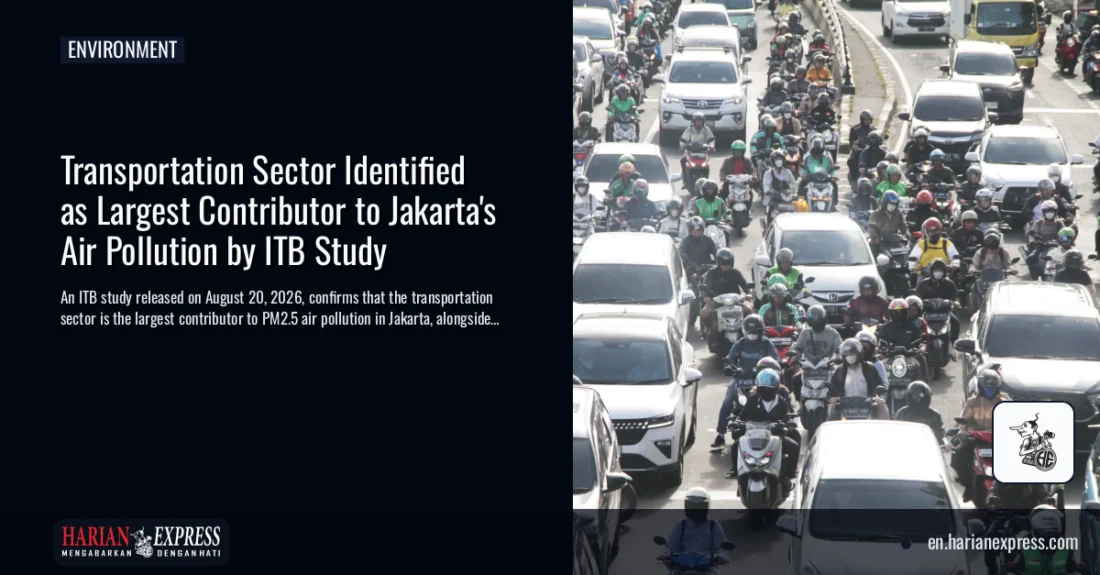
HARIANEXPRESS – A recent study by the Bandung Institute of Technology (ITB) revealed that the transportation sector is the largest contributor to PM2.5 air pollution in DKI Jakarta. The findings, presented on Thursday, August 20, 2026, also indicate that pollution from surrounding regional areas significantly impacts the capital’s air quality. This comprehensive research highlights the complex challenges Jakarta faces in addressing its persistent air quality issues.
The study underscored that addressing pollution effectively requires a multi-faceted approach, considering both local emissions and external factors. The research identified specific sources within the transportation sector that are most detrimental to the city’s air.
Transportation Dominates Jakarta’s Air Pollution
The ITB study, titled “Emission Inventory of Greater Jakarta (Jabodetabek)” and “PM2.5 Source Apportionment in Jakarta,” found that vehicles are the primary culprits behind fine particulate matter (PM2.5) pollution. Specifically, diesel-engine vehicles account for 32.4 percent of PM2.5 contributions. Meanwhile, gasoline-fueled vehicles are responsible for another 26.9 percent of these harmful particles.
Beyond vehicle emissions, other local activities also contribute to Jakarta’s air pollution. These include the industrial sector, waste burning, and construction activities. The study provides a detailed breakdown of these contributors, offering a clearer picture of the local emission landscape.
The Dangers of PM2.5
PM2.5 refers to fine particulate matter with a diameter of less than 2.5 micrometers. These particles are particularly dangerous due to their minuscule size, which allows them to penetrate deep into the respiratory system.
High exposure to PM2.5 in ambient air can lead to severe health consequences. These include an increased risk of asthma, Acute Respiratory Infections (ARI), lung cancer, and even premature death. The study emphasizes the critical health implications of Jakarta’s poor air quality.
The research team assessed PM2.5 samples in West Jakarta from February to December 2025. During this period, the average concentration of PM2.5 measured 34.1 micrograms per cubic meter. This level significantly exceeds the Indonesian government’s safe air quality standard, which is set at 15 micrograms per cubic meter.
Transboundary Pollution: A Regional Challenge
The ITB study also uncovered a crucial aspect of Jakarta’s air pollution: the significant influence of regional sources. High concentrations of PM2.5 in DKI Jakarta are affected by transboundary pollutant transport from industrial areas in surrounding buffer regions. This phenomenon results in pollutants moving from neighboring industrial zones and enveloping the capital.
The study’s modeling scenarios, which used AERMOD and WRF-Chem dispersion models, predicted the contribution of emissions from other areas to Jakarta’s air quality. It revealed that even if DKI Jakarta were to achieve zero emissions, the capital would still receive a substantial spread of PM2.5 pollutants from nearby agglomeration areas such as Bogor, Depok, Tangerang, and Bekasi.
This cross-border emission delivery was recorded to be in the range of 26 to 54 percent. On average, it contributes about 38.51 percent to the total PM2.5 concentration in Jakarta. The findings demonstrate that administrative boundaries alone cannot contain these pollutants.
“If Jakarta is considered to have no emissions at all, is there any effect? It turns out Jakarta still receives, there are still concentrations even if we zero out the emissions,” said Prof. Ir. Puji Lestari, Ph.D., leader of the ITB research team, when presenting the study results to the media in South Jakarta on Thursday, August 20.
Professor Lestari’s statement underscores that Jakarta cannot independently resolve its air pollution problem. The issue requires a broader, collaborative regional approach.
Implications for Jakarta’s Air Quality Efforts
The regional nature of the pollution poses a significant challenge for the Jakarta Provincial Government’s efforts to improve air quality. Despite local measures, external pollution sources can undermine these initiatives. This complex scenario demands coordinated action across administrative boundaries.
Pramono, representing the Jakarta Provincial Government, mentioned that the administration has been taking steps to address air quality issues. He highlighted that if industries and coal-fired power plants (PLTU) were not permitted, the impact on reducing Jakarta’s pollution problems would be far greater. He specifically referenced the Suralaya PLTU in Banten.
Gonggomtua E Sitanggang, Director of the Southeast Asia Institute for Transportation and Development Policy (ITDP) Indonesia, emphasized the necessity of improving public transportation integration across the Jabodetabek area. This includes enhancements in infrastructure, services, and institutional frameworks to encourage fewer private vehicle usages.
ITB Study Methodology and Findings
The comprehensive studies, “Emission Inventory of Greater Jakarta (Jabodetabek)” and “Source Apportionment PM2.5 in Jakarta,” were conducted by the Air and Waste Management Expertise Group, Faculty of Civil Engineering and Environment (KK PUL-FTSL) ITB. Prof. Ir. Puji Lestari, Ph.D., led the research team, with support from the ViriyaENB Foundation.
To predict the contribution of fine particulate matter (PM2.5) emissions from other regions to the capital’s air quality, the researchers utilized two types of air pollutant dispersion models. These models were AERMOD and WRF-Chem. Through modeling scenarios, the researchers were able to simulate various conditions, including a hypothetical scenario where Jakarta produced no emissions at all.
The core finding consistently pointed to the transportation sector as the predominant local source of PM2.5. This conclusion is based on detailed analysis of emission inventories and source apportionment. The study offers vital data for policymakers to formulate effective pollution control strategies.
Call for Collaborative Regional Solutions
The findings from the ITB study strongly suggest that a singular focus on Jakarta’s internal emissions is insufficient. Effective mitigation of air pollution requires a collaborative effort involving all regions within the Greater Jakarta area and beyond. Integrated public transportation is a key strategy to reduce emissions from the dominant transportation sector.
Addressing the complex issue of Jakarta’s air quality demands coordinated policies and actions across multiple sectors and administrative boundaries. The study serves as a critical basis for developing more robust and regionally integrated environmental policies. It highlights the urgent need for a comprehensive regional strategy to tackle the persistent problem of air pollution.