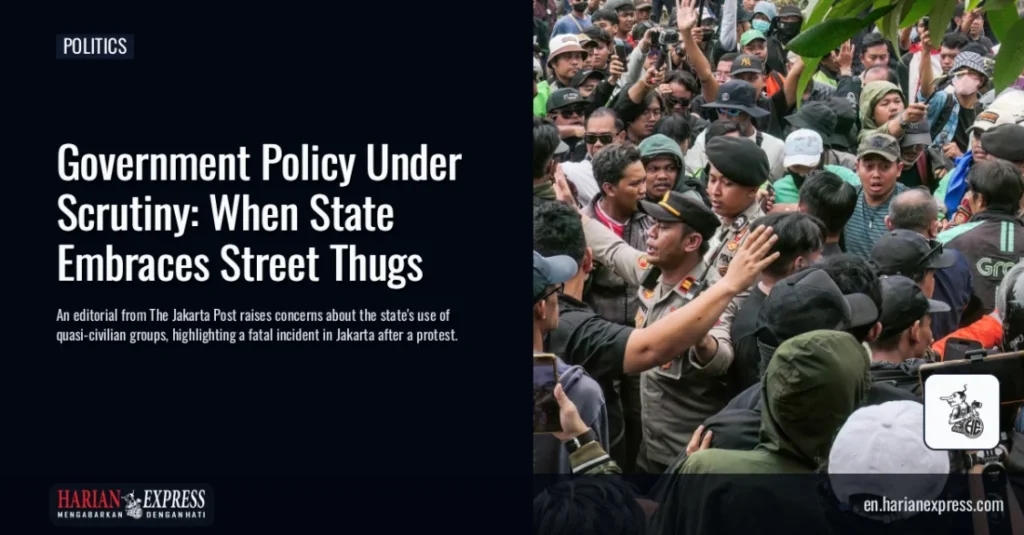
HARIANEXPRESS – An editorial published by The Jakarta Post on September 3, 2026, raises serious questions about the state’s role in allowing quasi-civilian groups to operate as political enforcers. This concern follows a violent incident in Central Jakarta on August 27, where a civilian was killed after a demonstration.
The editorial board of The Jakarta Post emphasizes that when the state adopts street thugs as political muscle, any ensuing violence is not accidental but rather a reflection of government policy. Such actions undermine the state’s moral authority when incidents turn violent.
Fatal Violence Follows House of Representatives Demonstration
On August 27, amidst the dispersal of crowds from a demonstration outside the Senayan Legislative complex in Jakarta, a tragic incident occurred in the nearby neighborhood of Pejompongan, Central Jakarta. Bambang Setiawan, a 59-year-old mirror maker, was killed, despite not being a participant in the protest.
Widely circulated videos from the aftermath of the demonstration depicted men in civilian clothing attacking local residents. Faturrohman, an 18-year-old madrassa student, was among those severely tortured during these attacks.
Amnesty International Indonesia subsequently called for an immediate investigation into the involvement of mass organizations in the violence. The human rights body highlighted that perpetrators were identifiable from the video footage yet remained at large for days following the incident.
Government’s Stance and the ‘Problematic’ Role of Ormas
The government’s characterization of mass organizations, specifically GRIB Jaya, at the demonstration as a “security contribution” has been identified as problematic by The Jakarta Post editorial. This official framing suggests a tacit acceptance of such groups in public order.
When the state deploys quasi-civilian muscle, it inherently relinquishes the moral standing to assign blame to the crowd for any violence that may erupt. This creates a dangerous precedent where accountability becomes blurred.
“When the state embraces street thugs as political muscle, the violence that follows isn’t an accident – it is government policy.”
Wilson Colling, a lawyer for GRIB Jaya, confirmed that the group’s leader, Rozario “Hercules” de Marshall, was present on the streets with his members during the unrest after the August 27 protest. However, Colling denied any alleged link between GRIB Jaya and the act of violence that resulted in a death.
Connections to Political Figures and Organizations
The editorial points out that the men responsible for Bambang’s death did not appear randomly, but rather operate within an environment fostered by deliberate political choices. Understanding these choices in practice is crucial for recognizing the root causes of such incidents.
Cabinet Secretary Teddy Indra Wijaya had two notable meetings with Hercules, further illustrating these connections. In March 2026, he received Hercules at his office for a post-Ramadan visit, which Teddy described warmly as a reunion with “an old friend of 15 years.”
Teddy Indra Wijaya met with Hercules again on June 19, just after midnight, and subsequently posted about this meeting on his office’s Instagram account. These meetings highlight the informal networks at play within political circles.
The mass organization GRIB was established in 2011 and has known links to Gerindra, the political party of President Prabowo Subianto. A report by Tempo in 2025 indicated that the group had entered its “golden age” following President Prabowo’s inauguration, suggesting increased influence and activity.
Further expanding this network, on August 7, Hashim Djojohadikusumo, the President’s brother, inaugurated 20 new mass organizations. These groups operate under the umbrella of the Forum Masyarakat Indonesia Emas (FORMAS), increasing its total membership to 103 groups.
Among these newly inaugurated groups is “Perisai Prabowo” (Prabowo’s Shield), a name that, as the editorial notes, requires no interpretation regarding its allegiance. This suggests a growing formalized structure for support groups.
The Broader Implications of State-Sanctioned ‘Muscle’
The pattern of the state engaging or allowing quasi-civilian groups to act as political muscle raises significant concerns about public safety and democratic principles. Such arrangements can blur the lines between official security forces and informal actors.
The incidents of violence following demonstrations, coupled with the official reception of figures like Hercules by government officials, suggest a troubling trend. This trend potentially normalizes the involvement of non-state actors in maintaining public order or influencing political outcomes.
The Jakarta Post’s editorial serves as a critical Viewpoint, urging a deeper examination of these political choices and their practical manifestations. It underscores the importance of state accountability and the rule of law in preventing future violence.