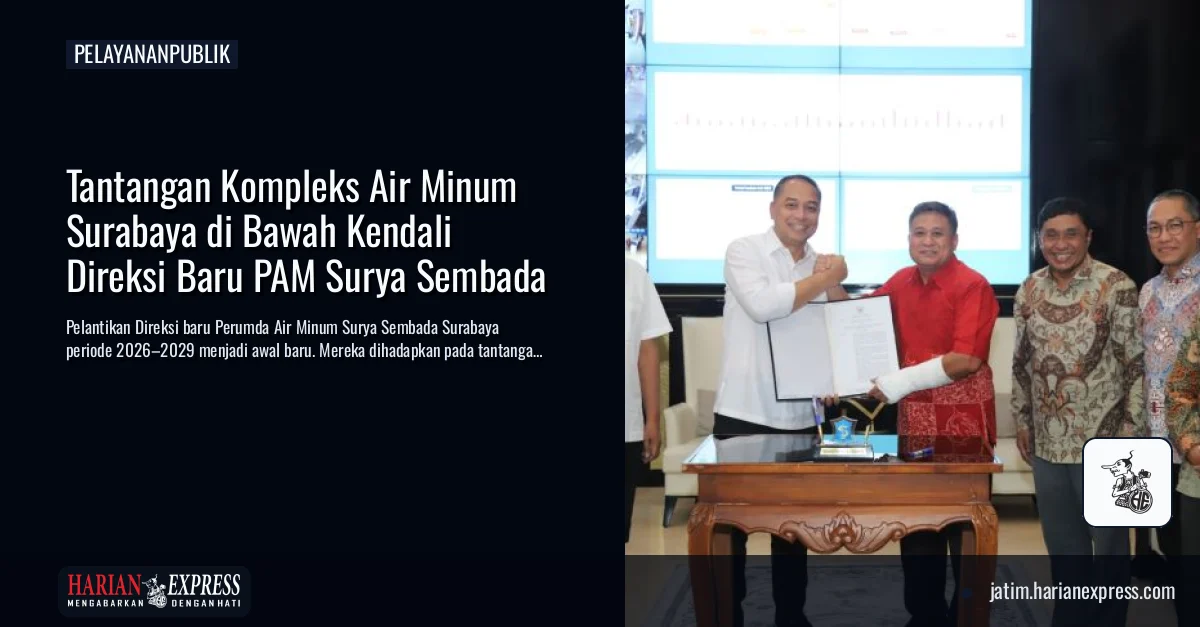
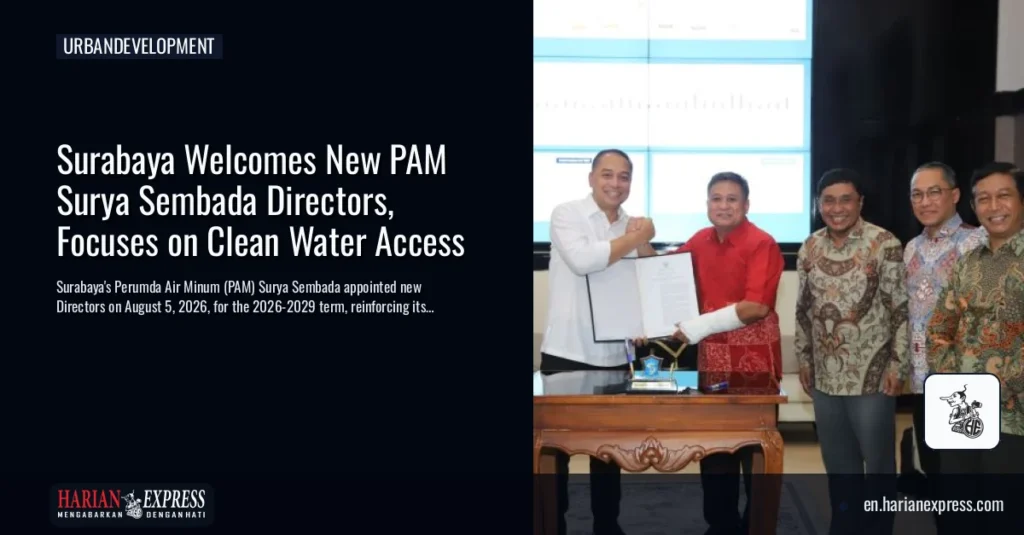
HARIANEXPRESS – Surabaya has reiterated its commitment to providing clean water with the inauguration of the new Board of Directors for Perumda Air Minum (PAM) Surya Sembada Surabaya. The swearing-in ceremony took place on Friday, August 7, 2026, at Balai Kota Surabaya, East Java, marking the official start of their 2026–2029 term.
This pivotal moment signifies a new chapter in addressing the complex challenges of drinking water provision as Surabaya continues its growth. The city is grappling with climate change, increasing community needs, and rising public service demands.
A New Era for Clean Water in Surabaya
Leading Amidst Growing Water Demands
Managing drinking water in a major city is far from simple, involving extensive work across various stages. This includes securing raw water sources, setting up treatment plants, developing piping networks, and implementing robust technology and corporate governance.
When water flow is disrupted, it extends beyond a mere technical problem. Such issues can erode public trust in the quality of public services.
The selection process for the new Board of Directors was rigorous, encompassing administrative checks, competency tests, psychometric evaluations, focus group discussions (FGD), business plan presentations, and interviews. The city government aims to appoint leaders who are not only adept in business but also possess strong integrity and a clear vision for public service.
These expectations are crucial given the unique nature of a water utility company. PAM Surya Sembada’s success is measured not solely by profitability but by the number of citizens who receive quality clean water services.
Consequently, the new Board of Directors has little time for adaptation. The community eagerly anticipates tangible results rather than just a change in officials.
Residents hope for smoother water flow, stable pressure, consistent quality, and prompt service responses during disruptions.
Addressing Myriad Challenges Ahead
Tackling Distribution and Service Gaps
Surabaya still faces significant challenges in water distribution in several areas where supply is not yet optimal. This situation often forces some residents to wait for specific times to receive water flow.
PAM Surya Sembada has a substantial task ahead: maintaining existing good services while expanding equitable service coverage throughout the entire city. Achieving the target of 24-hour clean water service is a particularly demanding indicator.
Reaching this target necessitates substantial investment in distribution networks, reservoirs, pumps, and water pressure control systems. All these investments require considerable financial resources.
Amidst the need for investment, the company must also safeguard its financial health to ensure sustainability. This dilemma is frequently encountered by many regional drinking water companies.
An excessive focus on profit could make services inaccessible to the broader community. Conversely, an exclusive focus on service without sound business calculations could jeopardize the company’s long-term viability.
A balance between social and business functions is key to success. The Surabaya City Government has guided the company not to solely pursue dividends.
The city government encourages the company to explore various financing schemes, including cooperation with investors, to accelerate network development without burdening the company’s finances. This approach aligns with practices in major cities worldwide, where water companies leverage partnerships to expedite infrastructure development, while the government maintains control over service quality and tariffs.
The success of this approach hinges on transparent governance, clear risk sharing, and the protection of customer interests.
Transforming Services and Work Culture
Embracing Digital Solutions and Field Leadership
Physical infrastructure development alone is insufficient in the current digital era. Water utility companies are also required to transform their services.
Customer complaints can no longer be adequately addressed through conventional counters. Rapid responses via digital applications, real-time network monitoring, and sensor-based leak detection systems are essential.
Customer data analysis is also a vital component of modern water service. Changes in work culture represent an equally important challenge.
The directive for Directors to engage directly in the field underscores the importance of leadership that is present amid challenges. Sound decisions are born from an understanding of the real conditions experienced by the community.
Upholding Public Trust and Climate Adaptation
Ensuring Water Security for All Citizens
Clean water is not merely an economic commodity; it is a fundamental human right and a foundation for life. Good water quality supports health, education, productivity, and economic growth.
Improvements in drinking water services will have a cascading impact on the quality of life for Surabaya residents. Therefore, the success of PAM Surya Sembada’s Directors over the next three years cannot be solely measured by positive financial reports.
Far more important indicators include a reduction in areas experiencing distribution disruptions. Additionally, faster handling of customer complaints will be a crucial benchmark.
Low water loss rates, wider service coverage, and high levels of public satisfaction must also be achieved. The next step involves fostering a culture of openness.
The public has a right to know about network development progress, service achievements, water loss rates, and the company’s annual targets. Such transparency can enhance accountability and strengthen community trust.
The company also needs to reinforce its climate change adaptation strategies. Variability in rainfall, the threat of drought, and increasing urban water demand necessitate the diversification of raw water sources.
Furthermore, conservation of water catchment areas and efficient water use are urgently required. Investment in more energy-efficient treatment technologies and distribution systems will also be a long-term necessity.
Simultaneously, educating the public on wise water use should not be overlooked. Water security is not solely determined by the company’s ability to produce clean water.
The community’s increasingly efficient consumption behavior is also a crucial factor in water security. The new Board of Directors of PAM Surya Sembada now bears a significant mandate.
They carry the hopes of millions of Surabaya residents who rely daily on the certainty of clean water. While these challenges are not light, there is a great opportunity to demonstrate that a regional company can serve as an example of professional, adaptive, and community-oriented public service. If a balance between innovation, good governance, sustainable investment, and humanistic service can be realized, then PAM Surya Sembada’s success will be evident not only through water flowing all day long but also, and more importantly, through the enduring trust of the community in their local government.