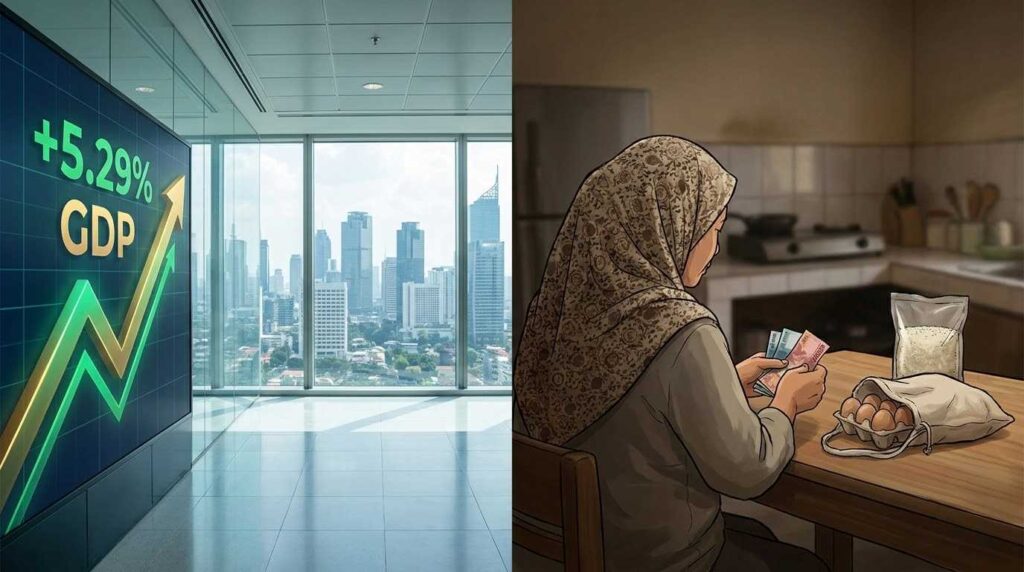
HARIANEXPRESS – Indonesia’s economy recorded significant growth in the second quarter of 2026, with the national economy expanding by 5.29 percent year-on-year. The Central Statistics Agency (BPS) reported this encouraging indicator.
During the same period, the number of employed individuals increased, the open unemployment rate declined, and the count of poor people decreased. These figures present a positive outlook for the nation’s overall economic performance.
Understanding the Macro-Micro Disparity
Despite these commendable macroeconomic indicators, a common disparity often arises: robust aggregate data does not always translate into a uniform economic experience for every household.
The crucial question is how effectively this growth creates decent jobs, boosts real incomes, strengthens small businesses, and enhances family economic resilience across the board.
Dissecting the Sources of Growth
Indonesia’s Gross Domestic Product (GDP) reached Rp6,552.1 trillion at current prices in Q2 2026, according to BPS data. This figure represents a 5.29 percent growth compared to the same period the previous year and a 3.73 percent increase from Q1 2026.
From the expenditure side, government consumption led the growth, surging by 15.97 percent year-on-year. Household consumption also grew by 5.28 percent, while fixed capital formation or physical investment increased by 6.43 percent.
These statistics indicate that the growth is not solely dependent on one component, although accelerated government spending provided a significant boost. Household consumption growing above 5 percent suggests that not all micro-level conditions are weakening; aggregate consumption and economic activity remain robust.
However, aggregate data does not fully explain the distribution of this consumption. An increase in spending by high-income groups can occur simultaneously with tighter spending among middle-to-lower income groups, meaning national consumption growth does not automatically imply uniform income increases across all households.
Therefore, the core issue is not merely whether the economy is growing, but rather who benefits most from this growth and through what channels these benefits ultimately reach the broader public.
Employment Trends: Beyond the Numbers
In May 2026, the workforce comprised 155.41 million people, with 148.19 million employed. The remaining 7.22 million people were unemployed, resulting in an Open Unemployment Rate of 4.65 percent, a slight decrease of 0.03 percentage points from February 2026.
BPS also reported the average worker’s wage at Rp3.39 million per month.
While the reduction in unemployment is a positive development, claims of it being the lowest in 30 years require careful consideration. Cross-decade comparisons must account for changes in population, workforce size, survey periods, and methodological consistency.
Moreover, the sheer number of employed individuals does not fully reflect the quality of jobs available. For households, the distinction between stable formal employment and unstable informal work significantly impacts their ability to afford basic needs, education, housing, healthcare, and loan repayments.
The risk of job loss also persists, as data from Satu Data Kementerian Ketenagakerjaan (Ministry of Manpower) recorded 15,425 workers affected by layoffs between January and April 2026. These individuals were categorized as participants in the Job Loss Guarantee program.
This figure, while not representing all national layoffs, still indicates pressure on certain business sectors and worker groups. Thus, declining unemployment and ongoing layoffs are not mutually exclusive; the labor market can create new jobs in aggregate while specific companies or industries continue to reduce their workforce.
Poverty Reduction and Economic Vulnerability
The number of poor people in March 2026 was 22.93 million, or 8.07 percent of the total population. This marks a reduction of approximately 430,000 people compared to September 2025 and about 920,000 people compared to March 2025.
Urban poverty decreased to 6.34 percent, while rural poverty stood at 10.67 percent. BPS set the national poverty line at Rp669,235 per capita per month, with food components accounting for 74.70 percent.
While poverty reduction is a significant achievement, a statistical exit from the poverty category does not automatically imply robust economic conditions for the family. Households just above the poverty line remain highly vulnerable to falling back into poverty due to illness, job loss, harvest failure, rising school costs, or declining business turnover.
Therefore, development success should not solely be measured by the reduction in the number of people below the poverty line. Equally important is a family’s ability to build savings, obtain social protection, maintain employment, and withstand economic shocks without having to sell productive assets or incur more debt.
Deflation and Retail: Mixed Signals
In July 2026, Indonesia experienced monthly deflation of 0.14 percent. However, annual inflation remained at 2.88 percent, with core inflation recorded at 0.14 percent monthly and 2.76 percent annually.
This temporal distinction is crucial; monthly deflation merely indicates slightly lower average prices in July compared to June. It does not mean prices have returned to previous year levels, nor does it signal that all commodities have become cheaper.
For households, inflation perception is heavily influenced by frequently purchased items. Families dedicating most of their income to food, transportation, rent, education, and healthcare may experience cost-of-living pressures differently from the average inflation rate.
Thus, monthly deflation signals price control during a specific period but is insufficient to conclude that the purchasing power of all segments of society has recovered.
The Bank Indonesia Retail Sales Survey indicated a 3.9 percent year-on-year drop in the Real Sales Index for May 2026, and a 1.5 percent monthly decrease. For June 2026, retail sales are projected to decline by 4.4 percent year-on-year and 0.8 percent monthly.
However, this pressure is not uniform across all sectors. Sales of spare parts and accessories still grew by 11.2 percent year-on-year in May, while information and communication equipment contracted by 18.4 percent. Clothing sales fell by 12 percent, and the food, beverage, and tobacco group declined by 4.1 percent.
This data supports the view that the retail sector faces pressure, but it is inaccurate to describe all trade activities as sluggish. Conditions vary significantly by product type, city, consumption season, and customer group. A more proportionate picture is that public demand persists but is becoming increasingly selective.
Consumers are tending to be more cautious, prioritizing purchases, comparing prices, delaying durable goods acquisitions, or switching to more affordable products.
Bridging Macro Growth to Household Well-being
Economic growth does not directly flow into every household’s bank account. Its benefits typically manifest through job creation, wage increases, business sales growth, investment projects, government spending, and increased demand for goods and services.
For families to fully benefit, the primary strategy isn’t high-risk investments, but rather strengthening financial foundations. This involves managing cash flow, controlling high-interest debt, building an emergency fund, and ensuring active health and employment protection.
Investment remains important but must align with individual goals, timeframes, liquidity needs, and risk tolerance. GDP growth does not guarantee asset price increases or profitability for every investment instrument.
For workers, the most tangible way to enjoy growth is by boosting productivity and the economic value of their skills. Competencies in sales, digital technology, data management, operations, marketing, and sectoral technical expertise can enhance opportunities for better jobs or income.
For Micro, Small, and Medium Enterprises (MSMEs), growth must translate into measurable market opportunities. Small businesses need to do more than just pursue turnover; they must maintain margins, separate personal and business finances, control inventory, accelerate accounts receivable collection, and develop products with recurring purchases.
Digitalization should also extend beyond mere social media account creation. Technology should be utilized for recording transactions, understanding customer behavior, inventory control, accepting payments, and building long-term consumer relationships.
Policies for Quality Growth
At the policy level, the challenge lies in strengthening the link between economic growth and public welfare. High government spending needs to have a broad multiplier effect by involving local producers, MSMEs, regional workers, and domestic supply chains.
The government should also prioritize the creation of formal and productive jobs, not merely reducing the unemployment rate statistically. Vocational training must align with industry needs, and protection for workers affected by layoffs must be easily accessible, coupled with effective job placement services.
Policies to strengthen purchasing power should target groups with a high propensity to consume, particularly low-income households and vulnerable groups. When their income increases, most funds will recirculate through daily essential purchases, thereby stimulating local businesses.
From Growth to Welfare
Recent data indicates that Indonesia’s economy is not in a completely fragile state. Growth remains strong, household consumption is positive, unemployment is declining, and poverty is decreasing.
However, these figures should not be used to dismiss the genuine experiences of people facing layoffs, stagnant incomes, declining turnover, or burdensome living costs.
Therefore, the phrase “macro brilliant, micro fragile” should be refined to:
Indonesia’s economy is growing quite strongly, but the benefits of its growth are not yet evenly distributed and have not fully transformed into household economic resilience.
The ultimate goal is not merely to sustain growth above 5 percent. Growth truly becomes meaningful when it generates quality jobs, increases real incomes, expands business opportunities, reduces vulnerability, and empowers families to face the future more confidently.
This is where economic success should ultimately be measured: not just by how quickly the GDP figure increases, but by how widely prosperity can be felt across society.