HARIANEXPRESS – The East Java Education Department has launched an innovative historical program titled “Murid Menjemput Sejarah : 81 Tahun Indonesia Merdeka” (Students Pick Up History: 81 Years of Indonesian Independence).
This initiative, which ran from August 12-16, 2026, aimed to educate students across 38 regencies and cities in East Java about the struggle and true meaning of independence.
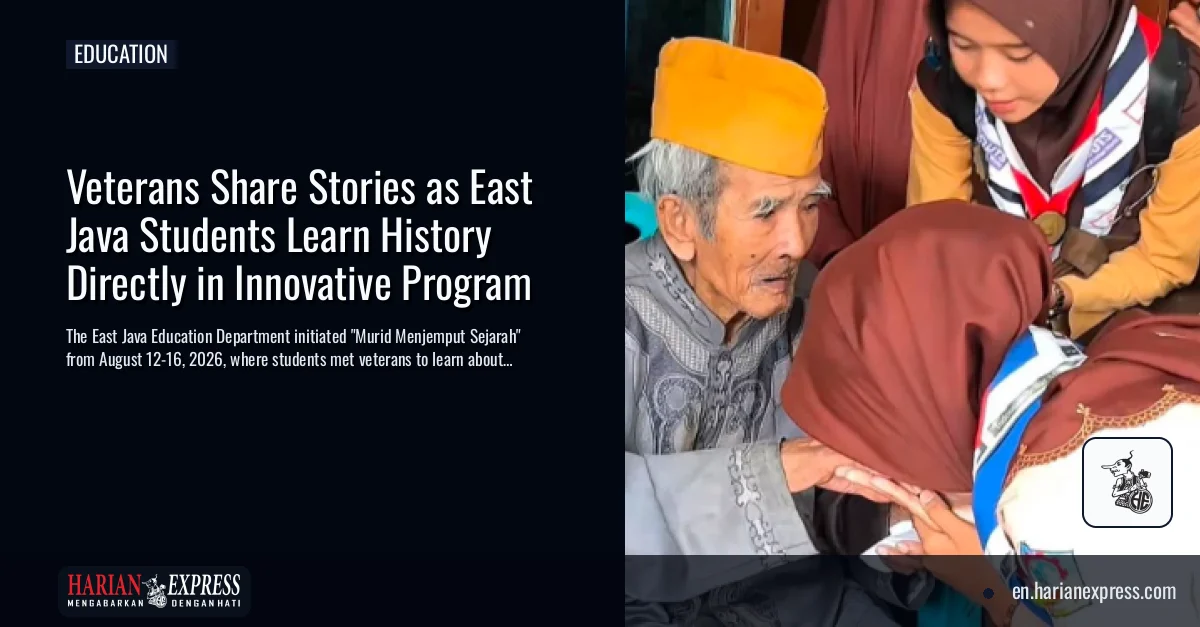
The program encouraged students and teachers from high schools (SMA), vocational high schools (SMK), and special needs schools (SLB) to visit veterans or the families of freedom fighters in their respective areas.
Connecting Generations: Learning Beyond Textbooks
Aries Agung Paewai, Head of the East Java Education Department, stated that the movement was designed to allow students to interact directly with historical figures, rather than just learning from books. He emphasized the importance of students meeting veterans and freedom fighters’ families firsthand.
“Students hear their stories, see their examples, and understand that the independence they enjoy today was obtained through extraordinary struggle and sacrifice,” said Aries.
The concept of the program was simple, with each school directed to visit at least one veteran or independence fighter. Students also brought gifts as a gesture of respect and appreciation.
Aries clarified that the gifts were not the main objective of the activity. The most crucial aspect was to foster care and connect the younger generation directly with history.
“Staple foods, blankets, or tokens of appreciation brought by students are not the main goal. The most important thing is to show respect, care, and gratitude from today’s generation to the fighters,” he explained.
Redefining Patriotism for Modern Times
Aries, who was born in Makassar, stressed that the spirit of struggle must be translated according to the challenges faced by the current generation. He believes that filling independence today is achieved not by taking up arms, but through education, achievement, social care, and positive contributions to the nation.
“We want to instill in students that filling independence now is no longer about taking up arms, but by studying diligently, achieving, maintaining unity, having social awareness, and giving something beneficial to the nation and state,” he asserted.
Each visit also resulted in documentation, capturing messages of independence from veterans for the youth. These messages were recorded in one- to two-minute videos or handwritten notes.
Aries views this movement as having the potential to become a distinctive model for character education in East Java. It uniquely combines historical literacy, social responsibility, respect for fighters, and local historical documentation.
“If books teach history, then veterans teach our children about the price of independence,” Aries remarked.
Enthusiasm and Real-World Lessons
Veterans expressed their appreciation for the program, with many reportedly moved by the students’ and teachers’ dedication. They were touched that the younger generation was directly engaging with history, beyond just what is found in books.
Through these visits, students discovered various living conditions among veterans. This included some living comfortably, others in simple homes, rented houses, or residences in need of repair.
This finding served as a significant social lesson, teaching students that honoring fighters extends beyond ceremonies to real-world care.
Several schools chose locations and historical figures with strong local ties. Students from SMAN 1 Ngrambe, for instance, visited the tomb of Ki Ronggo Lelono, an revered ancestor and former patih in Ngawi Regency.
Meanwhile, SMAN 1 Widodaren students visited the historical home of national hero dr. Radjiman Wedyodiningrat in Ndirgo Village. Sagimin, the tomb caretaker, recounted stories of the figure who once led BPUPKI.
In other areas, SMAN 1 Sukodadi visited war veteran Bandiyo. Students from SMAN 1 Wonoayu met Liem, a fighter from Dwikora, Trikora, and Sejora, and Sumiyatun, the wife of a Trikora fighter.
Aries hopes these experiences leave a deeper impression than classroom history lessons. He envisions students returning from these visits with invaluable takeaways: stories of struggle, exemplary conduct, an unyielding spirit, and a profound sense of responsibility to continue the struggle through education.
This initiative also aligns with the Dindik Jatim vision of “Jatim Cerdas, Pendidikan Berdampak” (Smart East Java, Impactful Education). This vision ensures that education extends beyond academic achievement to provide experiences and values that shape students’ character and their care for society and the nation.