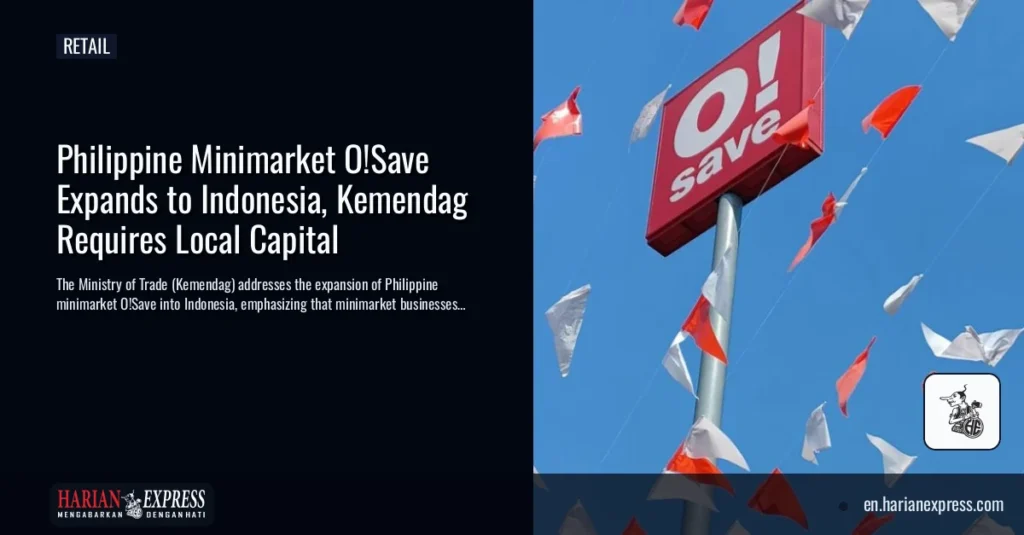
HARIANEXPRESS – The Philippine minimarket chain O!Save is expanding its operations into Indonesia. This move has drawn a response from the Ministry of Trade (Kemendag), which emphasizes that while foreign retail brands are welcome, any minimarket business in Indonesia must be operated with domestic capital.
Director General of Domestic Trade at Kemendag, Iqbal Shoffan, clarified that the presence of foreign brands does not automatically signify foreign investment. This is because the minimarket business format explicitly prohibits the acceptance of foreign capital.
Government’s Stance on Foreign Retail
Iqbal Shoffan confirmed that the origin of a brand does not dictate the capital status of the company running the business in Indonesia. He explained that even with an international brand, the company operating in Indonesia must utilize domestic funding.
“The minimarket retail format is not allowed to receive foreign capital. It must be domestic capital,” Iqbal stated when met at his office. “Even if the brand is from abroad,” he added.
Iqbal further cited examples of other foreign brands successfully operating in Indonesia under similar capital requirements.
O!Save’s Business Model in Indonesia
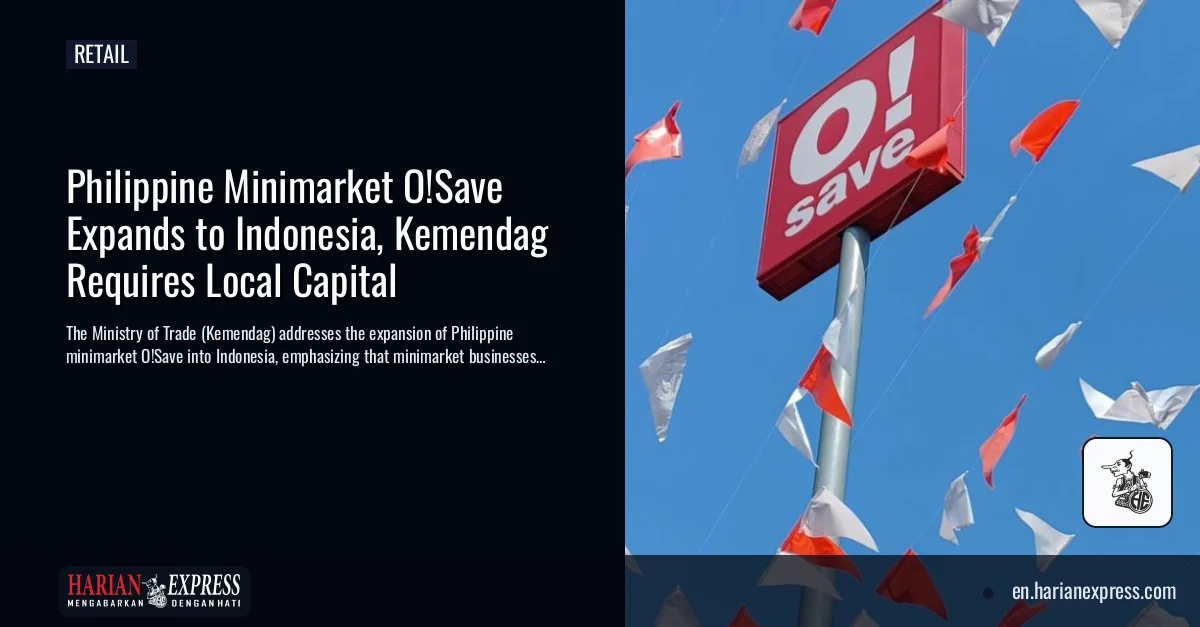
O!Save, a retail chain originating from the Philippines, was established in 2023. This minimarket adopts a ‘hard discount’ concept for its expansion within Indonesia.
The stores feature a simple design, avoiding expensive locations to offer the lowest prices every day without special promotions. O!Save focuses on providing essential needs, staple foods, household items, and personal care products for daily consumption.
Currently, O!Save operates 37 outlets across Jakarta. For new locations, the company requires a minimum floor area of 250 m², a commercial site of at least 350 m², and vacant land ready for lease measuring a minimum of 450 m².
Ideal locations include areas within or near trade zones, community centers, or residential areas, with a wide facade and adequate parking facilities.
Addressing Market Competition and Traditional Retail
Regarding competition, Iqbal believes that if retail businesses share the same format, competition is naturally subject to market mechanisms. However, the government pays special attention when competition arises between differing business formats, such as modern retail chains and traditional stalls.
Iqbal noted that traditional stalls cannot be directly pitted against modern retail networks due to their distinct capacities and business models. Therefore, the government is implementing various partnership programs to strengthen traditional stalls.
These initiatives include digitalization and collaborations with large distributors. “The government has an obligation to give special attention to traditional grocery stores,” he said.
Iqbal also addressed potential market saturation from the growing number of retail chains. He indicated that the current situation reflects a shift in consumer shopping patterns, rather than saturation.
Consumers are increasingly moving from monthly department store visits to more straightforward and practical minimarket formats.