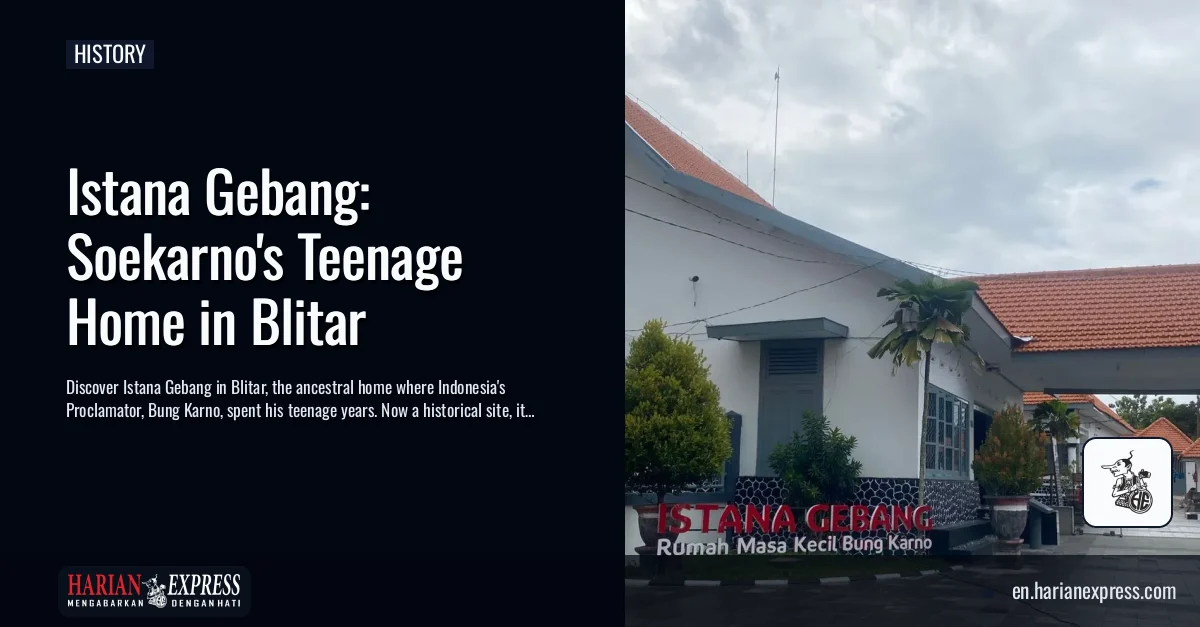

HARIANEXPRESS – Istana Gebang, an old family residence located in Blitar City, holds significant historical value as the place where Indonesia’s Proclamator, Bung Karno, spent his teenage years. This Dutch-style architectural building serves as a crucial link to Soekarno’s formative years after his father was reassigned from Mojokerto to Blitar.
Today, the site stands as a popular historical tourist destination, drawing many visitors eager to learn about its past. Blitar City also holds further importance as the final resting place for Bung Karno and his parents.
A Glimpse into Young Soekarno’s Life
detikJatim recently had the opportunity to visit this grand renovated building, located at Jalan Sultan Agung Number 59, Sananwetan District, Blitar City. A statue of Soekarno reading a book is prominently displayed in the home’s yard.
Soekarno moved to Blitar with his parents around 1917, at the age of 16, following his father’s new assignment.
Family History and Education
R. Soekeni Sosrodihardjo, Soekarno’s father, worked as a teacher and ‘mantri guru’ at the Normal Jongens School in Blitar, which is now known as SMAN 1 Kota Blitar. The family home, now called Istana Gebang, was purchased by Soekarno’s father from a Dutch railway employee.
“Pak Karno (Soekarno) was actually born in Surabaya, but he lived in various places. One of them was Blitar. Yes, this is his and his parents’ home,” said Hendro Agus Widodo.
Soekarno’s education continued in other regions; he attended high school in Surabaya and university in Bandung. His parents remained in the Blitar house until their retirement and passing.
Blitar’s Enduring Historical Significance
Beyond being Soekarno’s teenage home, Blitar also played a role in Indonesia’s struggle for independence. Soekarno held discussions about the PETA (Pembela Tanah Air) rebellion in Blitar with figures like Shodanco Soeprijadi, Shodanco Muradi, and Shodanco dr. Ismangil.
Although Soekarno reportedly wished to be buried in Batu Tulis, Bogor, West Java, the government at the time decided he should be laid to rest in Blitar alongside his parents.
“His will was to be buried in Batu Tulis, but the government at the time decided that Soekarno would finally be buried in Blitar along with his parents,” explained Hendro.
The historical sites related to Soekarno in Blitar, including Istana Gebang and Bung Karno’s Tomb, continue to attract significant public interest. These sites serve as important reminders of the nation’s history and the Proclamator’s legacy.
“Our hope is that the history of Bung Karno and his thoughts about this nation will continue to be preserved and passed on. Istana Gebang has also been renovated, becoming more beautiful and interesting. One of the aims is to invite the younger generation to learn about the nation’s history and struggle,” Hendro concluded.