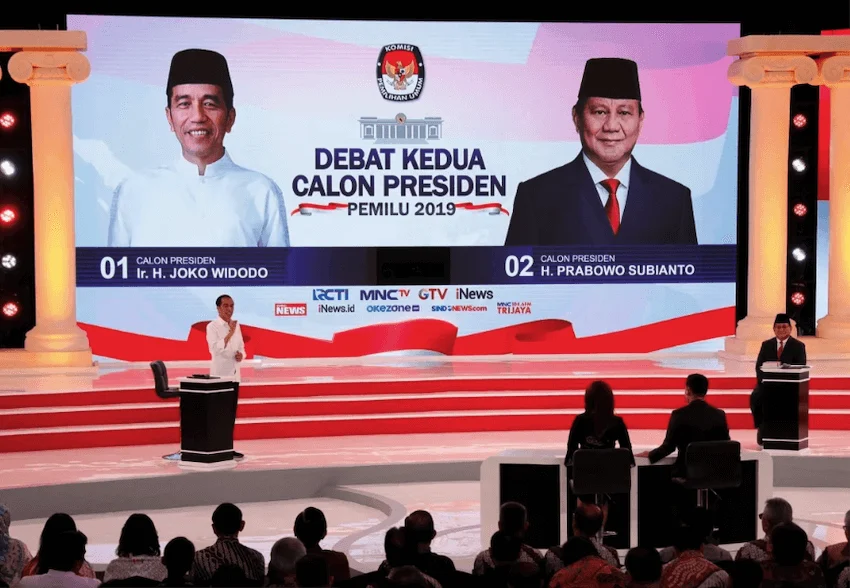
HARIANEXPRESS – Indonesia’s second presidential debate between incumbent President Joko Widodo and opposition leader Prabowo Subianto on Sunday night, February 17, 2019, sparked a livelier discussion compared to its predecessor, unexpectedly making “unicorns” a central symbol. The debate, held in Jakarta and broadcast live ahead of the April 17 presidential election, saw both candidates engage in more robust arguments, covering key national issues.
A Livlier Second Presidential Debate
The second round of debates began with a more heated tone, contrasting sharply with the lackluster first debate held last month. That initial event, which focused on law and human rights, left some Indonesians disappointed, with critics suggesting the speakers showed less skill than high school debaters.
This time, the general election commission in the country opted not to provide questions in advance, a factor that likely contributed to the improved dynamism. Netizens expressed that the debate was significantly more exciting and livelier, noting “stronger arguments” from both contenders.
The central themes for this second debate encompassed infrastructure, energy, agriculture, food, and the environment. Both candidates heavily relied on numbers and statistics, prompting national media to swiftly publish infographics detailing the cited figures.
The Rise of the “Unicorn” Symbol
A momentary confusion between the two opponents over “unicorn industries” soon became the unofficial symbol of the debate. During the exchange, Mr. Widodo questioned his opponent about his plans for developing infrastructure to support Indonesia’s emerging “unicorn” industry.
The term “unicorn” refers to a tech startup company that achieves a market value of US$1 billion. Indonesia currently boasts four such companies and anticipates having more than five by the end of 2019.
Mr. Subianto appeared unsure about the question, asking, “you mean … [that] online … online unicorn?” This moment of confusion elicited laughter during the live broadcast, and Indonesian netizens quickly responded by creating various unicorn-themed memes and circulating them widely.
Images depicting the candidates riding unicorns together or appearing as flying unicorns rapidly spread across social media platforms, making the presidential debate hashtag #DebatPilpres2019 trend on Twitter. Social media users also shared infographics to challenge their opponents online.
Contrasting Leadership Styles and Policy Approaches
The candidates presented distinct styles during the debate. President Joko Widodo opted for a casual look, wearing a white shirt, black chinos, and black and white sneakers, while Mr. Prabowo Subianto chose a full suit and a peci, a traditional cap commonly worn by Muslim men.
Sonny Muchlison, a fashion and style observer in Jakarta, commented on their appearances. He stated that the President appeared “humble and down to earth,” while the Opposition leader looked “stylish and full of confidence.”
Mr. Subianto maintained what he described as his “nationalistic and patriotic profile.” At the outset of his speech, he declared, “We have to stand on our own, we must be self-sufficient in food, energy, and water.”
Notably, Mr. Subianto also acknowledged some achievements under Mr. Widodo’s leadership, a gesture that garnered him praise for his perceived “honesty.” Experts analyzing the live television screening observed that Mr. Widodo demonstrated more vigor and superior preparation, effectively leveraging his incumbency advantage.
Debate on Agriculture and Food Policy
President Joko Widodo defended his administration’s performance in both infrastructure and agriculture sectors. Assyifa Szami Ilman, a researcher from the Centre for Indonesian Policy Studies, highlighted the clear differences in both candidates’ approaches to resolving Indonesia’s agricultural and food challenges.
During the era of former president Suharto, who was Mr. Subianto’s father-in-law, Indonesia was often characterized as an agricultural nation. However, Mr. Ilman clarified that the island nation has always possessed greater maritime resources.
“The misleading narration has resulted in a greater expectation that we have to source our food as an agricultural country,” Mr. Ilman. “This is a misconception, since 70 per cent of our territory is surrounded by ocean, so we have more water than land.”
Mr. Ilman also noted that five years of experience as president had led Mr. Widodo to believe that achieving agricultural self-sufficiency for Indonesia is “impossible.” The country currently imports several agricultural crops, including staple goods like rice, corn, and soybean.
Prior to the debate, Mr. Ilman had accurately predicted that Mr. Subianto would criticize the government’s import policy to challenge Mr. Widodo. Mr. Subianto indeed questioned the President on this matter, stating:
“I want [to] ask Mr Widodo, as president, on various occasions you said you would not import food commodities. It turned out that in the last four years you did a lot of importing … we have all the data. Honestly, from what we’ve heard it really hit the farmers.”
In response, Mr. Widodo explained that the imports were necessary to ensure Indonesia’s food supplies remained fully stocked. Mr. Ilman elaborated on this, saying, “Mr Widodo’s approach is more about food security. It doesn’t matter whether the food is sourced locally or imported, as long it feeds the people.”
Infrastructure Development Under Scrutiny
Regarding infrastructure, Mr. Widodo highlighted that under his leadership, over 600 kilometers of the “Trans Jawa” toll road had been constructed on Java, the main island. However, Mr. Subianto countered this claim by asserting that Mr. Widodo’s team operated inefficiently and that many government projects were undertaken without proper feasibility studies.
Explosions Near Debate Venue Cause Brief Concern
Outside the debate, security personnel were occupied investigating two explosions reported near Hotel Sultan, Jakarta, the venue for the presidential debate. The incidents occurred minutes after the debate commenced.
Antara, Indonesia’s news agency, reported that two explosions were heard from the east side of Bung Karno stadium, located less than a kilometer from the hotel. Supporters of Mr. Widodo had gathered at this stadium to watch the live debate on a large screen.
Local TV stations indicated that the explosions originated from firecrackers, and police confirmed there were no casualties from the incident. The National Campaign Team of Mr. Widodo expressed regret over the occurrence.
“This explosion incident must be thoroughly investigated,” said Maman Imanulhaq from the campaign team, as quoted by Antara News. “What is the motivation and who is the culprit, because this explosion has the potential to harm many people.”
Background of Prabowo Subianto
Prabowo Subianto, a 66-year-old former lieutenant general, has been linked to alleged human rights abuses. These allegations pertain to military operations in Timor-Leste and Papua, as well as incidents in Jakarta in 1998.
Candidate Styles and Debate Performance
The second debate also highlighted the differing styles of the two candidates. President Joko Widodo appeared casual, opting for a white shirt, black chinos, and black and white sneakers. In contrast, Mr. Subianto wore a full suit complemented by a peci, a traditional cap worn by Muslim men.
Sonny Muchlison, a Jakarta-based fashion and style observer, noted that the President’s attire conveyed a “humble and down to earth” image. Meanwhile, the Opposition leader projected a “stylish and full of confidence” appearance, aligning with his self-described “nationalistic and patriotic profile.”
At the outset of his speech, Mr. Subianto emphasized self-sufficiency, stating, “We have to stand on our own, we must be self-sufficient in food, energy, and water.” Notably, he also acknowledged achievements made under Mr. Widodo’s leadership, a gesture that earned him praise for his “honesty” from observers.
Experts closely monitoring the live television broadcast commented on Mr. Widodo’s performance, suggesting he displayed greater vigor and superior preparation. They observed that he effectively utilized his incumbency to his advantage during the exchanges, contrasting with the previous debate’s reception.
The Debate’s Lasting Impact
The second presidential debate, themed around crucial sectors like infrastructure, energy, agriculture, food, and environment, offered a more dynamic discussion than its predecessor. From detailed statistical arguments to an unexpected viral moment involving “unicorn industries,” the debate certainly captured public attention.
With Indonesia gearing up for its presidential election on April 17, the nuanced policy discussions, personal leadership styles, and even the brief scare from firecrackers near the venue, are all elements that will likely shape voter perceptions. The lively exchanges and distinct approaches presented by both candidates mark a significant point in the electoral campaign, leaving voters to weigh their choices.