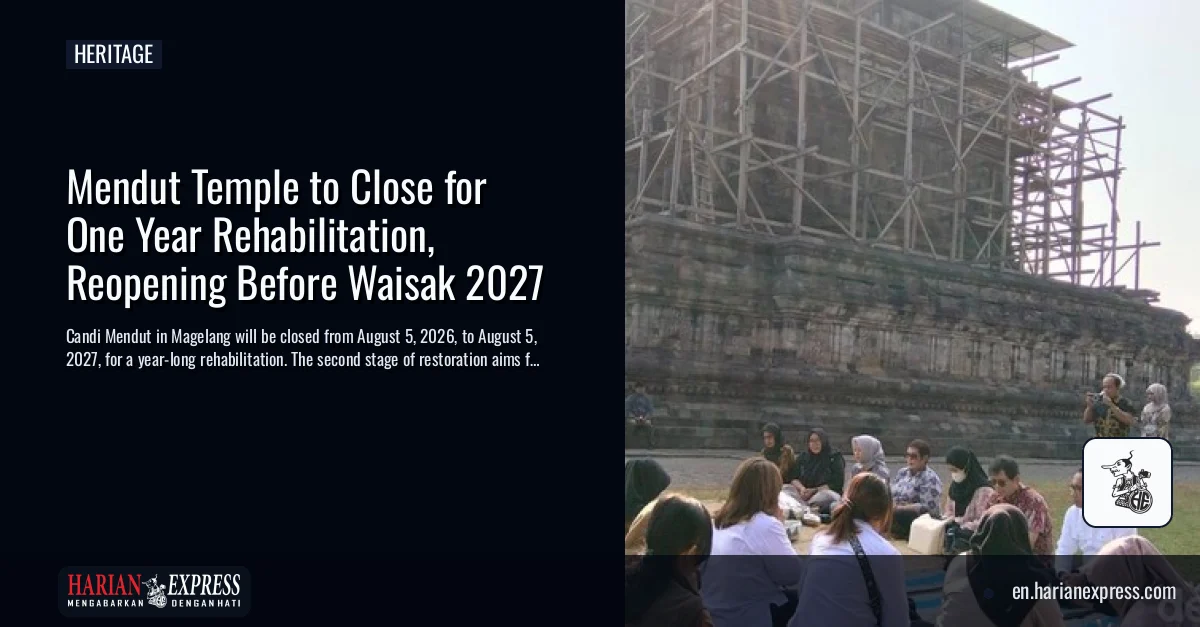
HARIANEXPRESS, MAGELANG – Candi Mendut in Magelang will undergo a full year of closure for rehabilitation, with the project targeted for completion before the Waisak 2027 celebration.
The temporary closure of Candi Mendut is scheduled to commence on August 5, 2026, and will last until August 5, 2027. This year-long period is allocated for the second phase of the temple’s rehabilitation program.
An official announcement regarding the closure for general visits has been placed at the entrance of Candi Mendut. Local vendors and parking attendants expressed hopes that the temple would attract more tourists post-rehabilitation.
“Suatu saat nanti kalau jadi bagus kan kita juga yang senang. Siapa tahu ke depannya semakin ramai. Tapi di sisi lain, selama 1 tahun itu nasib pedagang gimana,” ujar Siti Khotimah (33), pedagang suvenir di Candi Mendut.
Siti Khotimah, a souvenir vendor, confirmed that the temporary closure had been previously socialized, with initial information suggesting a two-year period, which was later accelerated.
According to Sugiyo, a parking attendant at Candi Mendut, a meeting was held on Wednesday, August 4, 2026, at the Museum and Cultural Heritage (MCB) with the vendors’ association. During this meeting, a socialisation regarding the temple’s rehabilitation, including compensation, was discussed.
Farnia Berliani Sri Tulodho, Head of the Magelang Regency Tourism, Youth and Sports Office (Disparpora), stated that the Ministry of Culture, represented by its Expert Staff and Head of the MCB Sub-Coordinator, met with Magelang Regent Grengseng Pamuji on Tuesday, July 21, 2026. The meeting addressed the second stage of rehabilitation for Candi Mendut.
Magelang Regency Government supports this rehabilitation plan as a national cultural heritage preservation effort and a world heritage site. Farnia added that the rehabilitation is expected to boost tourism in Magelang, attracting both domestic and international visitors.
The rehabilitation aims to restore Candi Mendut to its original form, including adding missing elements like the temple’s roof. Riris Purbasari, Head of the Central Java Cultural Heritage Preservation Center, explained that the second phase addresses previous leakage and bulging walls.
“Tujuan pemugaran ini untuk mengatasi hal-hal tersebut,” ujar Riris Purbasari.
Riris detailed that scaffolding from the first phase is still in use as water continues to seep into the temple’s chamber from the roof. This necessitates dismantling cemented sections of the roof, with original stones still present on the north side, which were prepared during the first phase for the roof’s shape.
The rehabilitation is allotted one year, with efforts to ensure it is ready for Waisak celebrations. Riris emphasized that the area must be completely closed for optimal and safe work, ensuring no interference from potential worshippers during the process.
Wiwit Kasiyati, Head of the Museum and Cultural Heritage Sub-Coordinator of the Borobudur World Heritage Unit, confirmed that work would extend into the night to meet the less-than-one-year target. This accelerated schedule is aimed at completing the project before Waisak so it can be used for worship.
Wiwit highlighted the significant economic benefits Waisak brings to the surrounding community of Mendut. Post-rehabilitation, the temple will undergo physical changes, including the installation of a stupa on top and the front façade, which will enhance its beauty.
After completion, Candi Mendut is planned for joint utilization with the Tourism Office, potentially including night visits. The necessary lighting installations are being prepared and repaired for this purpose.